Saturday, November 28, 2009

Ripe Art Gallery, Greenlawn, NY [53]


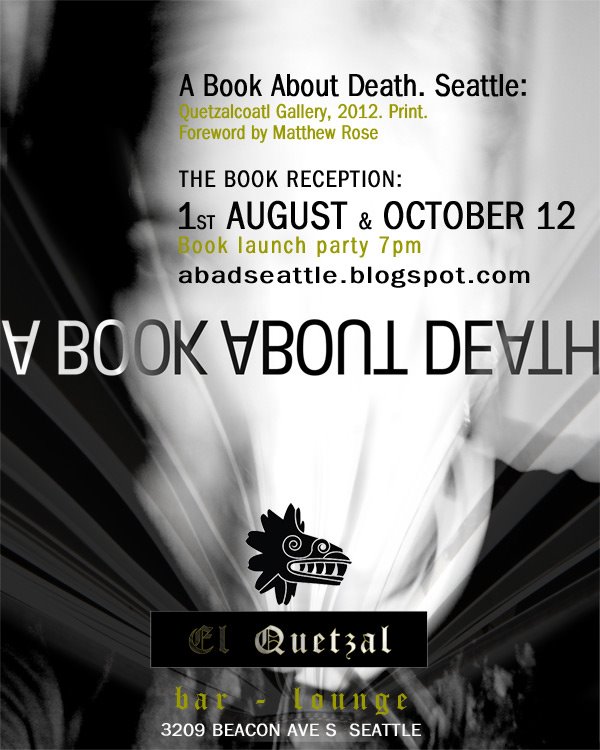
Louise Honey Millman sent these images from the October 2009 exhibition of the ABAD project at the Ripe Art Gallery in Greenlawn, Long Island, New York.

Photos: Owner Cherie in front of the gallery and artist Honey Millman checking out the installation during the opening.

Wednesday, November 25, 2009

Alix Lambert : The Body Farm [52]


Photographer and author, Alix Lambert contributed a work to the exhibition in New York City, but the postal gods had other plans when the cards were mailed to the gallery. We've tried to rectify that by featuring her work and the story behind it, a fascinating investigation into The Body Farm, located in a dead corner of the state, a no man's land of a completely different sort.  Alix writes ...

Beyond a sign that states in simple, unadorned fashion – Anthropology Research Facility State Forensic Anthropologist – are barren acres of fenced-in land. Unremarkable at best.  There is a shed, an abandoned trailer, some trees, dirt paths that lead nowhere it seems.

Walking through this nothingness towards its center in the cold autumn air, one discerns rows of dark green garbage bags, laying side by side. You can laugh, almost; if you had to guess, they might be covering bodies. Twenty yards closer and you see yellow sashes wrapping around one tree trunk and running to the next. The unmistakable words CRIME SCENE are written in black.

And then you see, as if for the first time, what's really here: Skulls and an assortment of femur bones among the leaves, and bodies in varying states of decay. If you look very closely, that movement that you thought was a trick of the eye turns out to be swarms of maggots gnawing on the human remains.

The Facility, or The Body Farm, as it has been nicknamed much to the chagrin of some who work here, is dedicated to the study of the rate of human decomposition, a key understanding needed in murder trials.

The Facility was founded by Dr. Bill Bass and is affiliated with The University of Tennessee.  Although other “body farms” have been planned in the US, this one remains the only one of its kind in the world.

For a man who oversees the very end of the end, Dr. Bill Bass is all charm and smiles. Twice my age, he seems to have twice my energy. He's almost gleeful for someone who works all day with corpses. Standing on the Tennessee soil, bodies in varying states of decay all around us, he happily answered questions he's answered thousands of times over the past years.

"We are not a culture of death," he says about how we as people tend to hide from view all that happens after we die. "Let’s say for example there were a body out on the road; someone was killed and thrown out on the edge of the road. The police are called. They come and they hold up a sheet so that no one can see what’s going on and everybody drives by looking and looking but they can’t see anything. Then the body gets put in a black disaster bag, again no one can see what they are doing. The body bag goes to the morgue; well they don’t give tours of the morgue, so no one knows what goes on in a morgue and if they ever do see that individual again it might be at the funeral - if they have an open coffin. But if they don’t then the person is buried and nobody ever sees it."

"There are so many things that happen after people die that we have closed off in our culture, and essentially said, ‘you can’t look at that.’ Bass goes on: "I think people wonder ‘what goes on behind those closed doors?’ I don’t know why we cover it up. Of course, there are certain cases in which you don’t want to let everybody know what happened. I don’t think you ought to let key evidence out, but I don’t see any reason why we shouldn’t go into great depth about what goes on.”

Dr. Bass allowed me to photograph the Body Farm, and the results have taken me on a very strange and sometimes beautiful journey, regardless of morbidity of the subject.


Conversations with some of the researchers at the body farm revealed narratives that one might only find in Hollywood.  One researcher, Joanna Hughes, recalls: "When I was in third or fourth grade, I remember, there was a person found somewhere in my home-town in a refrigerator in the woods, and somebody had done a facial reconstruction and that just kind of stuck with me. Then in the seventh grade, one of my science teachers asked what do we want to do when we grow up? And I said, 'I want to put faces on skulls.' I didn’t know what it was called. I didn’t know if it was a real job, I just knew that that’s what I wanted to do. So, here I am."

Joanna Hughes was adopted as a baby as was her brother; she grew up in Alabama, in the South. Her parents were very religious; she knew from the day her parents picked her brother up that he was evil, she said. During the course of our conversation, she went on to discuss the murder of her parents by her brother, who was sentenced to death in 2005, and killed himself in 2006.

"As my brother’s last surviving family member, I made the decision to donate my brother’s body here to the facility. He did no good in life and if he’s just buried in a hole he won’t do any good in death. If he’s here he can do good for however long they have his bones. A lot of people don’t understand. They were asking ‘When’s the funeral? Are you going to bury him next to your parents?’ I don’t think they’re thinking it through. I really don’t care what they think. This is the best thing that he could possibly do. He’s doing it and I don’t have a problem with it."


I come to realize that we are interested in – or sometimes obsessed with – our own humanity, and the “vessel” that contains whatever we deem ourselves to be. The recognition, as I look at the bodies around me that, yes – this is my vessel, too.

The work I presented for the project, A Book About Death, comes from this series of photographs.  And, as fate had it, the photo post cards were either lost or destroyed in the mail, never making it to the exhibition. So, in a bit of black humor, I've exhumed them here, and would be more than happy to send a card to anyone who is missing one in their collection.  The remaining cards will be going to MUBE in São Paulo, in February, for the next chapter in this itinerant book about death.


Please contact Alix Lambert if you would like to have one of these cards for your collection from the exhibition.  Her e mail: lixilamb@gmail.com. Alix has a full text on her investigation of the body farm, and you will find it on her site. You will also discover her photographs and her book, CRIME. Click here: http://pinkghettoproductions.com/

Tuesday, November 24, 2009

Ryosuke Cohen's Brain Cell [51]

The Japanese artist Ryosuke Cohen, who for decades has been sending out waves of his Brain Cell sheets of rubber stamp images across the planet, picked up on Peter Dowker's mailing (below) in his edition No. 752. The sheets are typically A3 size and something of a magazine of the various logos and phrases and images in rubber stamps that pour into the artist's studio.

Writes Peter in explaining why Ryosuke didn't directly contribute to the project: "I think he has a mission to produce 150 copies of these rubber stamp prints every 10 days and he doesn't stray too far from that. But the fact that he chose this to include over anything else on the card shows that it didn't go unnoticed."  [See Peter Dowker's website, FLIP FLOP MAIL ART].

Peter sent a detail of the Cohen piece: "It's strategically located next to a great OH BOY Ray Johnson stamp "Eating Toejam."

Ryosuke Cohen is something of a mirror of global mail art activities.  See his web site and blog here: http://www.ryosukecohen.com/

Cohen writes on his site: "Recently, I have observed many signs that make me feel as if Mail Art is drawing to a close, and that there are many past publications that could be seen as 'compilations' of Mail Art. Quite a few predecessors of Mail Art have passed away, including Ray Johnson (USA), the Father of Mail Art, G.A.Cavellini (ITALY), Robin Croziel (ENGLAND), Robert Rehfeldt (GERMANY), G.Deisler (GERMANY), Carlo Pittore (USA) and others. This is probably also because exchange by mail in the age of computers is considered primitive, and after the end of the COLD WAR between the East and the West, the necessity of correspondence between those two different worlds has been lost. On the other hand, I have been regularly receiving mail art by mail and fax, in response to my BRAIN CELL PROJECT dating from the year 1985, which has been numbered issue No. 652, as of June 2006.


Every time I receive mail art, I am pleased to see more and more new participants. After making them a collage of their drawings, designs, logos, seals, stickers and the like, I make it a rule to send the finished project back to each participant.

Mail Art is far from finishing. I appreciate the role of collaboration in Mail Art. It is important to have new participants each time, but it is more important to be evoked by other mail artists' ideas from within the large and deep Network with a diverse range of expressions and concept. I can make mail artists' ideas more interesting by actively availing myself of seals and stamps and other materials sent from others and through my own printed matter. What is more, I can give other mail artists the feeling that they can utilise other's art and collaborate their ideas."

Monday, November 23, 2009

MUBE - São Paulo, Brazil : Call For Works. Exhibition Februrary 2010 [50]


MUBE: Museu Brasileiro da Escultura, opens a new chapter in A Book About Death with a new call for art works for exhibition February 6 - 28, 2010.  http://mube.art.br/

A website set up specially for the exhibition by organizer Angela Ferrara will document the show as it happens. http://umlivrosobreamorte.blogspot.com/

PLEASE SEND:

SINGLE WORKS: Approx. 6" x 9" 
MEDIUM: Open; all works accepted
THEME: A Book About Death
DEADLINE: January 30, 2010

MUBE – Museu Brasileiro da Escultura is asking for submissions from artists throughout the world as a critical part and new chapter in the exhibition of the “A Book About Death” collaborative project. This exhibition at MUBE opens on February 6, 2010 and runs through February 28.

“A Book About Death” is a collaborative project conceived by American artist Matthew Rose for the Emily Harvey Foundation in New York City, where the original exhibition took place from September 10 - 22, 2009. Approximately 500 artists contributed 500 artworks in the form of post cards of varying sizes each created from works made especially to create an unbound book about death.

The exhibition paid special homage to Ray Johnson (1927-1995), a highly influential figure in contemporary American art, a formidable collage artist and long acknowledged as the "Father of Mail Art" with his creation of a network, The New York Correspondence School. The exhibition also paid homage and celebrated the life of Emily Harvey (1941-2004), the late art dealer who tirelessly promoted Fluxus artists and whose Foundation generously supported the project.


The exhibition opened with a packed house, and a line snaking up Broadway more than 500 people long waiting to get in the doors to make their own book. Since then, the exhibition has traveled to the Otis College of Art and Design in LA, The River Mill Art Gallery in New Jersey, The Mobius Gallery in Boston, MA, The Queens Museum in Queens, NY, The Sexta Literary Arts Festival in Tijuana in Mexico, as well as smaller galleries and schools in Louisiana, Wisconsin and Long Island. Complete sets of "A Book About Death have entered into the permanent collections of the Museum of Modern Art (Library), and the LA County Museum of Art Research Library.

The project, in its sprawling, global reach explored how we celebrate memory and consider death. The only requirement to participate in the project was to include the words “A Book About Death” somewhere on the card.


ART CALL: SEND WORKS TO MUBE, SAO PAULO, BRAZIL. DEADLINE JAN 30, 2010

We are also asking individual artists to submit works, either a single card or a group of cards for exhibition at MUBE.

Ideal dimensions are approximately 6" x 4" either horizontal or vertical orientation, but variations in size are permissible. We would like to ask all artists to be aware that we need to easily install works on the wall, so consider this aspect of the exhibition.  Artworks can be handmade or printed commercially. You can mail the card by itself or in an envelope. (Please make a digital capture of the works for your records).

A deadline of January 30, 2010 has been set for reception of all submissions, although we
will install any cards received after that date. Digital works are not accepted, sorry. To be included in this exhibition, make a postcard on the theme of death and send it to:

MUBE – Museu Brasileiro da Escultura
Avenida Europa, 218 – Jardim Europa
CEP 01449 000 - São Paulo - Brasil

All works submitted to MUBE will become a part of the permanent collection of the Museum, and will not be returned.

Documentation online of all new works will be made over the course of the next few months.

http://mube.art.br
http://umlivrosobreamorte.blogspot.com/
http://abookaboutdeath.blogspot.com/
http://abookaboutdeatharchive.blogspot.com/

FOR INFORMATION, PLEASE CONTACT :  Angela Ferrara (atelierferrara@gmail.com)
http://angelaferrara.com/ or http://blog.angelaferrara.com/

Matthew Rose :  http://abookaboutdeath.blogspot.com/

Carta Aberta

MUBE - Museu Brasileiro da Escultura aceita artistas de todo o mundo para apresentar seus trabalhos como parte de um novo capítulo na exposição "Um livro sobre a Morte”, que acontecerá de  6 a 28 de
fevereiro de 2010.


"Um livro sobre a morte" é um projeto colaborativo concebido pelo artista norte-americano Matthew Rose na Emily Harvey Foundation Gallery, em Nova York. A exposição original ocorreu durante o período de 10 a 22 de setembro de 2009. Cerca de 500 artistas participaram, cada um deles contribuiu com uma série de 500 obras de arte sob a forma de cartão  postal, obras de tamanhos variados criadas especialmente para compor páginas desacopladas de um possível livro sobre a morte.

A exposição fez uma homenagem especial ao artista  Ray Johnson (1927-1995), uma figura influente na arte contemporânea norte-americana, consagrado como o "Pai do Mail Art", e como criador do The New York Correspondence School. A exposição também homenageou e consagrou a vida de Emily Harvey (1941-2004), que com a sua fundação apoiou e promoveu generosamente projetos de artistas Fluxus.

A bem sucedida mostra em Nova York, recebeu um sua primeira noite mais de 500 pessoas. Desde então, a exposição já viajou para o Otis College of Art and Design em Los Angeles, The River Mill Art Gallery in Nova Jersey, The Mobius Gallery em Boston, MA, The Queens Museum in Queens, NY, The Sexta Literary Arts Festival em Tijuana, México, assim como galerias e escolas em Louisiana, Wisconsin e Long Island. Coleções completas de "Um livro sobre a morte” foram adquiridas para o acervo permanente do MOMA – The Museum of Modern Art, e para o acervo do LA County Museum of Art Research Library em Los Angeles.

Um projeto de extenso alcance global explora as diversas maneiras de como nós celebramos a memória e a morte. O principal requisito para participar deste projeto é a inclusão da expressão "Um livro sobre a Morte" em qualquer parte do cartão. As obras tem como base as dimensões 10 x 15 cm, em orientação horizontal ou vertical, mas variações de tamanho, formatos e materiais são admissíveis. Podendo ser feito manualmente, impresso ou a combinação de ambos. Desde que os artistas estejam conscientes de que precisamos instalar as obras facilmente na parede.

Os artistas poderão enviar um trabalho único ou um conjunto de obras. O prazo de recebimento se encerrará no dia 31 de janeiro de 2010. Desculpem-nos mas obras digitais não serão aceitas. Para que os artistas sejam incluídos nesta exposição, fazer um cartão postal sobre o tema da morte e envie para:

MUBE - Museu Brasileiro da Escultura
Avenida Europa, 218 - Jardim Europa
CEP 01449 000 - São Paulo – Brasil

Todos os novos trabalhos apresentados ao MUBE passarão a fazer parte da coleção permanente do Museu, e não serão devolvidos. Documentação on-line de será feita ao longo dos próximos meses.

http://mube.art.br/
http://umlivrosobreamorte.blogspot.com/
http://abookaboutdeath.blogspot.com/
http://abookaboutdeatharchive.blogspot.com/

Obrigada,

Angela Ferrara (atelierferrara@gmail.com)  http://angelaferrara.com/   http://blog.angelaferrara.com/

Friday, November 20, 2009

A Book About Death – THE REMAKE [49]


A Book About Death – REMAKE is an Unbound Art Exhibit

The initiative by Louisiana State University Digital Art students is yet another take on the exhibition that took place in New York, and involves a large, student-wide project to recast the show in a local, personal way that has meaning to the students and, to the local community. Left, one of the posters made by an LSU student.  Other posters reproduce the originals in new ways.

Below is the text announcing the exhibition, and on the website set up for the show, there are many pre-installation pictures and information about the show. Below, right, one of the students organizes the works for installation.

Exhibition : December 4 - 16, 2009
Opening : December 4, from 7 - 9PM
Location : 200 Government St, Baton Rouge, LA

http://abookaboutdeath.tumblr.com/

A Book About Death - REMAKE is a local re-interpretation of the collaborative, globally produced exhibition A Book About Death that was first presented this September at the Emily Harvey Foundation in New York.

LSU Digital Art students set out to join this project and remake the exhibition in downtown Baton Rouge. The result, A Book About Death - REMAKE, is a 'pop-up' exhibition, taking place in a non-traditional venue in the unfinished retail space and lobby of the former Coca-Cola bottling plant at 200 Government Street.


Please join us for the opening celebration on December 4 from 7:00PM to 9:00PM. Come for food, drink, art and performance and to participate in the making of live video art.

See the LSU web site for the project and pre-installation shots, re-made posters and more information about this exhibition.

Monday, November 16, 2009

Un Libro Sobre La Muerte En Tijuana [48]


Un Libro Sobre La Muerte en Tijuana, organized by Bibiana Padilla Maltos, opens at The Primer Festival Literatura en las Artes 09 España La Sexta House of Music, Tijuana, Mexico, 21 Noviembre 2009.  Site.

A Book About Death, es el título original de la exposición colectiva de 500 artistas que contribuyeron con más de 500 postales y 500 copias de ellas. El creador de este proyecto es el artista Americano Matthew Rose, quien propuso que se creara un libro de postales sueltas con cada uno de los trabajos de los artistas participantes, esto es pues, una exposición colectiva que a su vez es interactiva, en la que el público puede llevarse cada colaboración consigo, haciendo ya sea un catálogo completo, o un catálogo de selección personal.

Un libro sobre la muerte es también un homenaje tanto a Ray Johnson como a Emily Harvey, ambos artistas impulsores e inovadores del movimiento Fluxus.


Primeramente presentado en la Emily Harvey Foundation Gallery, en Septiembre de 2009, en la ciudad de Nueva York, A Book About Death se ha montado en diversas ciudades estadounidenses y otros países como Brasil y Canadá. Así mismo el itinerario de esta exposición incluye: Bélgica, Alemania, Francia, China, entre otros.

ABAD (apodo que se le otorgó seguido de la inauguración), se encuentra en diversos hogares tanto del público general que ha asistido a las exposiciones interactivas en la galería de la Fundación de Emily Harvey y OTIS en Los Angeles, así como artistas, galerías, y dentro del catálogo del Museo de Arte Contemporáneo, en Nueva York (MoMA).


DOWNLOAD A HIGH RES VERSION OF BEN'S POSTER, CLICK HERE.

PHOTOS: Above, left, Ben Elmer's image from A Book About Death used as a poster for the festiva. Above, right, Bibiana Padilla Maltos holding the poster made for the project by Osiris Hertz.

Saturday, November 14, 2009

A BOOK ABOUT DEATH : THE MOVIE [47]


Angela Ferrara, an artist based in São Paulo, Brazil, created this film 
for the exhibition A Book About Death. Angela, contributor to 
A Book About Deathsee her art here – worked tirelessly to not 
only learn new software applications but to curate the original 
show into themes and sync it all to the beautiful music of 
Garry Schyman – his piece, Praan.
Visit The Music Of Garry Schyman

Praan
Bhulbona ar shohojete
Shei praan e mon uthbe mete
Mrittu majhe dhaka ache
je ontohin praan
Bojre tomar baje bashi
She ki shohoj gaan
Shei shurete jagbo ami
(Repeat 3X)
Shei jhor jeno shoi anonde
Chittobinar taare
Shotto-shundu dosh digonto
Nachao je jhonkare!
Bojre tomar baje bashi
She ki shohoj gaan
Shei shurete jagbo am


Praan (English Translation)

The same stream of life
that runs through my veins night and day
runs through the world
and dances in rhythmic measures.

It is the same life
that shoots in joy through the dust of the earth
in numberless blades of grass
and breaks into tumultuous waves of leaves and flowers.

It is the same life
that is rocked in the ocean-cradle
of birth and of death,
in ebb and in flow.

I feel my limbs are made glorious
by the touch of this world of life.
And my pride is from the life-throb of ages
dancing in my blood this moment.


Use of Garry Schyman's music for Praan – originally written for Where The Hell Is Matt? – has been generously granted by the composer.

 
Lyrics adapted from the poem "Stream Of Life" from Gitanjali by Rabindranath Tagore.

Music Credits: Music By Garry Schyman.  Drums and Engineering Dan Blessinger. Vocals Palbasha Siddique. Guitars and bass Kevin Dukes. Concertmaster Belinda Broughton. Orchestral contractor Ross DeRoche (DeRoche Music Inc.).  Vocal Contractor Melissa Nixon.

Thursday, November 12, 2009

Last Dance: Queens Museum Of Art [46]


Selections from A Book About Death at The Partnership Gallery in The Queens Museum of Art will close on Sunday, November 15, but not without  a party.  From 3 to 6pm you can join artist and curator Louise Weinberg (pictured here, waltzing with one of the artists) for a look at the installation and the more than 165 new works sent in for this exhibition. (Louise notes that no works will be returned to the artists).

The exhibition brought many artists from the original project in contact with nearly 200 more from all over the world who responded to Weinberg's call for new artworks.  These pieces, along with their envelopes, were installed in vitrines, on walls using a simple clothes-line system and in large glass cases in the gallery.


Many of these pieces were made by children in the workshop at the QMA, while others came from Europe, South America and across the United States. Votives and homage works for friends and loved ones, and even Neda, the young Iranian woman killed in the election battles in Tehran, came pouring in to the gallery.  Visual essays using collage, drawing and digital techniques took on the complex subject of death; but the works were unusually uplifting, particularly in their sense of humor and their head-on take-no-prisoner's approach to death, dying, murder and oblivion.

"It was a tireless but extremely rewarding experience," says Weinberg.  "Another chapter in a vast and wonderful collaborative project."

Other artists are currently working in Mexico, Montreal, São Paulo, Brazil, Belgium and even Beijing (where public Internet access to even this web site is prohibited) to put on the exhibition in new and varying ways, inviting the local community to contribute and dipping into the deep well of global collaborators to expand the venue.

Last days at the Queens Museum.  Closing November 15, 2009, from 3 - 6 pm: Queens Museum of Art, New York City Building, Flushing Meadows Corona Park, Queens, NY 11368.

[Installation shot above: Nora Gomez, all other photos: Louise Weinberg].

Wednesday, November 11, 2009

Tamar Kasparian : The Collection [45]

A BOOK ABOUT DEATH - OPEN A BOX from Tamar Kasparian on Vimeo.


Artist Tamar Kasparian received a box from Mara Thompson filled with works from the project.

Thursday, November 5, 2009

Queens Museum of Art : Installation [44]


Some views of the installation of A Book About Death, curated by Louise Weinberg. (November 1 - 15, 2009). Click the image for largest possible view. Photographs by Louise Millman.

Louise Weinberg invited artists to contribute single works by mail to the Queens Museum exhibition and the response was in the hundreds.  Works came from all over Europe, the US and of course Mexico which heartily celebrates El Dia De Los Muertos throughout the country.

The exhibition included works from A Book About Death, the posters from the Emily Harvey Foundation exhibition in NYC, as well as videos and Phil Shinn's presentation slide show about euphemisms used when discussing death.  That slide show can be seen in its entirety below.

Louise Weinberg dedicated this chapter in A Book About Death to the memory of Moki Cherry, Minnie Weinberg and Nancy Spero. Here, in this space, we would like to add Rebecca Lipkin, who was a great friend, a bright and beautiful light and who left us way too early.

Sunday, November 1, 2009

Letter From Mark Bloch : On My Participation In A Book About Death [43]

Mark Bloch, artist, performer and author, reflects on his piece and participation in A Book About Death, citing Ray Johnson as the center of his performance art at The Emily Harvey Foundation the night of the opening.

I voluntarily made a poster for A Book About Death by taking Marcel Duchamp’s art work “Fountain,” a urinal turned on its side and submitted for inclusion in a 1917 art show to which anything was supposedly acceptable, and substituting it for the many crosses that disappear into the horizon as grave markers in Normandy, France, where D-day occurred. Duchamp hailed from Rouen, nearby, and so I thought it was a fitting tribute to both the heroics and futility of death as well as Duchamp, the fountainhead of the avant garde for me and for the generation that came before me.

But the true story of my involvement with the recent A Book About Death links not directly to Marcel or to graveyards but to three “books,” none yet published and all conceptual on some level or another. First and foremost, the American artist Ray Johnson (1927-1995) the founder of the New York Correspondence School deserves all the credit for creating the concept of A Book About Death because he was really onto something when he came up with the concept in 1963.

Between March of that year and February 1965, he sent out 13 pages or so of something he called A Book About Death. In framing one piece of a paper as one page of a conceptual book, he anticipated many literary developments of the four decades that have followed. Ray Johnson’s A Book About Death connects to hypertext, cyberpunk, the internet, as well as devices like the Kindle, a device that is an accumulator of electrons that shows its user pictures on a screen of what can be thought of as a book. But the Kindle, one of the possible signposts of what the future of reading will be like, cannot show us an entire book. It can only show us one page at a time.


The second “book” is the biography I am writing of Ray Johnson. In 1995 when he died, I had already been trying to piece together the details of his life for my own edification. Since then I have completed dozens of interviews about him and thousands of hours of research into the details of his life and his activities. I have many boxes of files about him, the art he sent me, notes on our phone calls which he considered part of his art, and copies of what I sent him. There are files on the many people he was involved with and the names he dropped. To be writing a book about Ray Johnson is to be indirectly linked to almost everything in the world and also the afterlife. My book about Ray is a huge undertaking that only gets larger. Some day I would like to stop researching my fascinating subject and start writing but I am not sure how to define the boundary between these two activities.

The third “book” is Three Ugly Islands my own three-part autobiographical work of temporal distortion, influenced by many things including the concept of "The Death of the Author" by Roland Barthes. In my book the hero Martial Panterel is a performance artist and secret Kaballist who knows very little Hebrew but grabs little pieces of things that remind him of the Talmud, a link between text, the spiritual realm and pictorial writing, because he believes his superimposing the oeuvre of Marcel Duchamp over Jewish mysticism holds the key to his dilemma. Less the “writer” of his book but more someone determined to impose order over it, he sets off on the insurmountable task of moving his own unwieldy four dimensional scrapbook, which he calls The World Accordion, containing ephemera, documentation, explanations and detritus of his own life, from place to place, in search of clues to his existence and the plot of his story which is increasingly overwhelming and confusing.

Thus, my original thoughts about a project that would use Ray Johnson’s concept of A Book About Death as a “jumping off point” were pretty much what manifested themselves almost a year later after I suggested to Matthew Rose that to unify the project, and as an homage to our mutual friend Ray, that participants in the project could include the words A BOOK ABOUT DEATH on every card, identifying itself as part of a whole. I moved in that direction when I made my own card about Ray and his original idea. When the project was complete I noticed only a dozen or so other people referenced Ray in their cards. The rest that did not were mostly about death, also an appropriate subject, of course.


The other idea I proposed to Matthew Rose, the project’s organizer, was that there be some sort of panel discussion on Ray and his “book” concept during the run of the exhibition. He did not follow that suggestion but he did invite me to perform at the opening, for which I was grateful. This resulted in my appearance there as a one-man panel discussion in costume as Ray Johnson’s A Book About Death itself. I had glued dozens copies of the loose pages of Rays book to myself until I resembled a Michelin Tire Man of my own literary aspirations.

In the crowded gallery space, stripping to my underwear, I began the performance when I put on this immense costume, which my wife Amy Scarola helped me transport to the gallery by taxi. I suppose it really began earlier that evening, when I decided to carry with me to the gallery by subway, thousands of pages of my Ray Johnson research as part of the piece, muttering to the other passengers like a crazed paper-bound gypsy and even dropping the pile at one point on the subway floor. Prior to that, standing on the subway platform, combining all my thoughts on the subject of the past several months, I had composed a text to read in thirteen parts or sections called “books.”

Once the performance “officially” began with my introduction by Matthew Rose, I was joined by Blbiana Padilla Maltos who I had spontaneously asked to assist me by handing me each of the folders of my research one at time as I listed them. I felt like a paper-pushing Harry Houdini with Bibiana as my stage assistant. To end the performance I had made a decision to blow my papers with an electric fan, in a move that hearkens back to a performance Jean Dupuy, a former residence of this very gallery space at 537 Broadway, who once blew pepper on an audience through a vacuum cleaner.

Performing on the same bill as Carolee Schneeman and following Brandstifter's Keith Buchholz’s and Cecil Touchon’s conceptual pieces was an honor. I enjoyed all of them a lot. I predicted in the press release that this event would be a terrific show and a Happening and it was.


As I alternately stood and sat in that suit, reading from my performance “score,” just as I did when I composed it, I let Ray lead me from the grave, something I spoke about in my piece. After all, the late Mr. Johnson had made death the center of his work and my own mystical leanings view the connection between life and death as an illusory veil always waiting to be penetrated, in both obvious and not-so-obvious ways. I did my best to penetrate it that night to keep Ray centered in the overall scheme of things which I thought was important to the largely uninitiated audience. An awareness of Ray, his communication art innovations and his connection to mystery are sure to be helpful when considering any “book” about “death” or any A Book About Death.

Visit Mark Bloch's website, click here.

[PHOTOS: Mark Bloch Poster;  Mark Bloch performing opening night by Michael Chan; the artist with his files and assistant; Ray Johnson, source unknown.]

Brandstifter NYC Performance : Das Band des Todes / The Tape of Death [42]


Brandstifter's original performance, Das Band des Todes, at A Book About Death, September 10, 2009 at the Emily Harvey Foundation Gallery, NYC, NY.

Zunächst stellte ich mich allen Besuchern der Emily Harvey Galerie persönlich vor und bat sie über ein Mikrofon ihren Namen auf eine Audiokassette in meinen tragbaren Kassettenrecorder zu sprechen. Bei der Performance spielte ich dann das Band mit den vor einer Stunde aufgenommen Namen und Hintergrundgeräuschen von der Ausstellungseröffnung ab. An den Anfang der Kassette hatte ich den Hinweis, dass alle nachfolgend genannten Personen sterben werden, aufgenommen. Nachdem der letzte Name verkündet war nahm ich die Kassette aus dem Abspielgerät, drängte mich durchs Publikum, zog dabei das Band aus der Kassette und verband damit die Anwesenden. Ich weiß nicht ob jemand der Teilnehmer mittlerweile verstorben ist, aber wir werden...

– Brandstifter, New York, 10/31 2009

Brandstifter (Firestarter) is an interdisciplinary Artist and Networker from Germany, and is currently Balmoral Artist in Residence at Flux Factory, New York. Through Happening and Visual and Perfomance Art, as well as sound and music, he uses communicative means of social interaction to transform anarchic concepts from everyday life into burning-down-the-house Intermedia. See Brandstifter's website : www.brand-stiftung.net

Thursday, October 29, 2009

Queens Museum of Art Poster [41]


Artist and curator Louise Weinberg asked me if I could produce a poster for The Queens Museum of Art.  Above is the result, with wonderful typography help from David Rager, a designer who produced one of the original posters for the exhibition at The Emily Harvey Foundation.  You are free to download and print this out; the high resolution PDF will scale quite large.

This image is from my series, A Perfect Friend.

If you are in Queens this weekend, please attend the opening.  More than 100 new works have been mailed in to the Queens Museum over the last week.  "And there are more coming everyday," said Louise.  Photographs of the installation will be posted soon.

In the meantime...

DOWNLOAD THE QUEENS MUSEUM OF ART POSTER FOR A BOOK ABOUT DEATH.

Tuesday, October 27, 2009

Peter Ciccariello : Reflections On A Homeless Book About Death [40]


Peter Ciccariello, painter, poet and contributor to "A Book About Death," offers his reflections on his experience visiting the gallery with his wife Sandra... 

[Photo: Sandra and Peter Ciccariello. Below, Peter's contribution to the project]

The idea was brilliantly simple: Artists would contribute 500 post cards each to create an unbound book about death to be exhibited at the Emily Harvey Foundation Gallery in New York City. Visitors were invited to assemble their own ‘book’ which was then an ‘exhibit’ in itself. If you had a complete set, you could, in theory, produce the exhibit in another town, another country, or in your own living room.

On Friday, September 18th, Sandra and I took the number six subway downtown to the gallery on Broadway determined assemble our own ‘book’. I was quite unprepared for the solemnity of the task, the boxes of cards were lined up in rows along the floor, the empty white painted gallery space, all referents suddenly to little coffins in a stark bright empty church. Both of us immediately began the process of collecting one postcard from each box. 

With her disciplined eye for data acquisition, Sandra’s determined approach was to assemble a complete set, mine was to more or less let the cards speak to me somehow in a random intuitive way, and those would be our personal books. Both of us found immediately that there was so much more here than expected, and our silence spoke of how overwhelmingly profound the project and the process was. The experience was not unlike the grief, and bottomless, nameless emotions and contradictions of actually confronting the death of one’s lover, child, sibling, pet or parent, or even one’s own. Cards about unforgivable suicides, about being old and finally giving up, unexpected, unacceptable deaths, and quiet, welcomed ones. How each card represented that fine and private space inside us all, that space we would prefer to ignore and pretend did not even exist at all.


After about an hour and a half, we had our sets, two huge piles of cards balanced and unruly in makeshift plastic bags, the sharp edges poking out, almost violently, as if they had a life of their own, these cards about death, this formless, homeless book about death that I had now taken responsibility for, that I would lug all over New York City, back to Grand Central, and back to Rhode Island. Later, on the train, we went through the bag, one by one, sharing the most painful, the most joyous or the most horrifying. Finally coming to a sense that this was perhaps what death was all about. No beginning or end, just an endlessly unique, precious, and personal narrative told by those still living, carried on our backs forever, offered to anyone that has the sense and compassion to listen.

 * * * * *

Peter Ciccariello is an interdisciplinary, cross-genre artist, poet, and photographer. His work is a pastiche of language and text in 3-D digital environments. His image “Poem filled with terror" was part of A Book About Death. Peter lives and works in Providence, Rhode Island.  Visit his web sites: http://invisiblenotes.blogspot.com/ and twitter feed: https://twitter.com/ciccariello

Saturday, October 24, 2009

Angela Ferrara : Uma carta do Brasil [39]


Uma carta do Brasil : Houve um tempo de muita depressão e eu quis experimentar a morte, um tempo acompanhado de pesadelos e pavores noturnos. Em um de meus pesadelos eu havia conseguido passar para o mundo dos mortos, mas minha angustia continuava, sentia me como “Agnes” do filme de Ingmar  Bergman. Acordei aliviada por estar viva e decidi me dar uma segunda chance, busquei ajuda em sabedorias milenares e aprendi de alguma forma que a morte é uma extensão da vida, que as fugas nos levam ao caminho inicial e que atalhos não existem. Três anos depois, recebo da artista Vera Goulart um e-mail sobre a exposição chamada “A Book About Death,”senti uma atração imediata pelo tema e entrei em contato com Matthew Rose, eu imaginava que além da homenagem a Ray Johnson, haveria um motivo muito forte para essa realização....


Um pouco depois eu ví uma colagem feita por Matthew Rose, havia uma mulher linda, do tipo das antigas atrizes de hollywood sentada em uma prancha, pronta para saltar para o desconhecido, em baixo estava escrito Doris Rose (1925-2009).

“A Book About Death” também possui um caráter de manifesto contra a violência mundial, representado pelo rosto de uma jovem em Tehran. Acompanhei os trabalhos que estavam sendo enviados, cada um com uma impressão muito forte de cada artista, consegui ver as varias faces da morte, a face cômica dos trabalhos de Rob White, a morte cravada no peito como nos trabalhos de Ria Vanden Eynde, que exorciza suas dores como Frida Kalo. O trabalho de Sarah Clayton me fez pensar na proximidade da morte e do sono profundo.


A sutileza gráfica de Branka Djordjevic mostra a fragilidade da vida. Jane Wang me fez ver a linha tenue entre depressão e morte. O coelhinho de pelúcia de Patti Singer sugere que a morte não poupa crianças. Talvez a morte seja a fusão no outro como em Betty Esperanza. Como a antiga musica os mortos podem dançar em Keith Buchholz. Mark Bloch expressa todo seu talento fluxus na interpretação da morte. Bibiana Padilla consagrou a visão do cemitério. O belo sofá vazio de Sonja Benskin demonstra saudade de alguém. Eva Brunner me transportou as cenas de Eugène Atget em Paris. O lindo palimpsesto cheio de nuances do tempo de William Evertson. A morte projetada no tempo como em Louise Weinberg. Também me chamou a atenção o trabalho de Yoko Ono, onde as árvores nasciam em cima de caixões de madeira, isso me remeteu as lendas indígenas brasileiras. Cada artista em sua singularidade mostrou uma visão única que enriqueceu o todo. Gostaria muito de falar da riqueza estética de cada um dos quase quinhentos trabalhos, mesmo não sendo possível expresso minha total admiração e gratidão por cada um deles. Finalmente em meu trabalho eu quis expressar a crença em algo além da vida, algo como este projeto que mesmo tendo sido programado para “morrer” insiste em viver, em ganhar o mundo.

Resumo sobre a vida de “A Book About Death” (Um Livro Sobre a Morte) A mostra “A Book About Death” idealizada e organizada pelo artista Matthew Rose (norte-americano que vive e trabalha em Paris) foi realizada em setembro na Emily Harvey Gallery em NY, EUA. Matthew Rose convidou quase 500 artistas de todo o mundo para participarem da mostra de mailarts em homenagem a Ray Jonhson, muitos dos artistas são envolvidos com o movimento Fluxus como Yoko Ono.

Cada artista colaborou com 500 cartões, que durante a mostra poderiam ser escolhidos pelos visitantes para fazerem o seu próprio livro sobre a morte. Artistas partilharam suas visões sobre a Morte e a morte foi vista por diversos ângulos. A exposição havia sido programada inicialmente para “morrer” quando todos os cartões acabassem… Mas antes que isso acontecesse “Um Livro Sobre a Morte” adquiriu vida e uma artista envolvida com o projeto “Jane Wang” levou a exposição para Boston no The MOBIUS Gallery, enquanto isso o MOMA, Museu de Arte Moderna de Nova York mostrou interesse e está adquirindo a coleção para seu acervo permanente. Como se não bastasse a pós-vida do “Um Livro Sobre a Morte,” uma outra integrante do grupo Mara Thompson com a ajuda de Bibiana Padilha levou a Mostra para a Otis College of Art and Design de Los Angeles. Em Los Angeles também o “Livro” esta sendo adquirido pelo Los Angeles County Museum of Art Research Library, Los Angeles. Também foi para The River Mill Art Gallery em New Jersey e já está marcado para iniciar outra mostra no dia dos mortos no Queens Art Museum em Queens, New York, graças a outra integrante do grupo Louise Weinberg. Todo o mérito a Matthew Rose que do Facebook coordena todos os artistas engajados neste projeto, e mérito também dos artistas por manterem o idealismo “Paz e Amor” típico dos anos 60 bem vivo em tempos difíceis. Digo idealismo porque os artistas do grupo ainda se correspondem freneticamente por MailArt mantendo a essência da mostra “A Book About Death” em homenagem a Ray Johnson! Já estão sendo organizadas exposições em Montreal, Ciudad de México, Berlim e possivelmente São Paulo.   (Foto: Angela Ferrara, in her studio, São Paulo, Brazil).

O Fotografo francês Ari Rossner, amigo de Matthew Rose está em São Paulo para verificar a possibilidade de expor “A Book About Death” na cidade. Se alguma Galeria ou Museu de São Paulo tiver o interesse em expor este projeto tão original, por favor entre em contato.

Aguardamos as próximas atrações de Um Livro Sobre a Morte – A Book About Death….
++++
– Angela Ferrara [http://angelaferrara.com/]

Thursday, October 22, 2009

Caterina Verde : Death & Other Stories [38]


Skype, March 2009
matthew rose (paris) -- hey verde...
caterina verde (east hampton, ny) -- mister rose...
mr -- say, i have a project i'm working on.
cv -- oh yeah? what kind of project?
mr -- it's called a book about death. an unbound book on death. should be very interesting.  i was thinking – do you want to make the website?
cv -- a website on death? not sure, maybe, perhaps, what's it involve?
mr -- it involves hundreds of artists, maybe a thousand.
cv -- uh, well, um...no.

Yeah, okay, so Mister Rose had a way of convincing me to do the website. It became "The Wall," a massive design that included every artist submission to what has become A Book About Death. And, I must admit, I became rather obsessive about it, in that I not only succeeded after months, in getting nearly 1000 images onto a single page (so that the page could expand), but so it would be a big open book where all the artists were present, and their worlds connected.  It had to be something of a memorial, but also something of a living work, a window that constant changed and constantly said, open this thing up...the worlds of the artists who contributed and the content that they shared. 

As I began to design the site, much like many of the artists in this project, reflecting on death and how my life has been touched by it.  Death has had a huge impact on my life – so working on this project provided yet another reason to help this unbound cause of international proportions.

A Story About Me About Death

Well, death has been all around me since I was eight, like a rain cloud that followed me from bed to school.  Some have had the good fortune of living their lives along a fairly even progression, think babbling brook or Route 70.  Grandparents leave us first, the parents 20 or so years later...and ultimately we leave this cozy world, and the song goes on and on. I suspect that the majority of the world does not have that luxury. I haven't.

My mother was diagnosed with breast cancer when I was just learning to understand who she was, and over the next six years I watched her slowly die. I was 14, just starting high school. Nobody wanted to hear about a dead woman.  The year before my mother's death one of my classmates died at age 13. Russell was on the operating table for open heart surgery.  That was my first hit of reality that you could die young. A year or so later, two teenagers who worked as stock-boys for my father died; one was 16 the other 17.  The youngest died in a car accident while the other was driving; then the older boy hung himself in his parents' back yard. "Mom and Dad...I'm home." 

Seems like a common enough thing to say, but when you bite into life after these events, it's never the same, never common.

I suppose I became a bit wild then with news of yet another of my classmates shooting himself in his parent's bedroom while they were on vacation.  That must have been a happy surprise. My close friend in high school, Tim, also shot himself in his bedroom with a big shot gun.  In his suicide note, he blamed it on his girlfriend. That must have kept her right in the head. I had danced with Tim the week before and he seemed happier than he had ever been.  So much for happiness.  School friend No. 3 was run over by a car while he was in a drunken stupor. He was 16. The daughter of a friend of our family who had obtained her license only recently died when she hit a tree after leaving a party. She was beautiful and bright; her mother was almost suicidal at the loss. To round things out during this four year period of what seemed like unrelenting loss, my beloved grandfather died in Mexico.  He was 77. At least this had some kind of natural order. It wasn't a war zone but it felt like one. I've since realized that I probably could have been diagnosed with some version of PTSD [Post Traumatic Stress Disorder].  Those were times when you were just supposed to shut up, and go back to school. The result was: I didn't have a right to live. Yet, I was beginning to feel a bit like a specialist. And some years later my cousin Noah was shot and killed by a gang in a drive-by shooting in San Francisco. My uncle, Jack Greene, made a piece about Noah (his son). It's now one of the pages in A Book About Death. 

My father always said he wasn't afraid to die.  But when my brother and I watched him die three years ago he didn't look exactly relaxed.  He had left some very serious unfinished business and now he understood that he was dying and there was nothing he could do to fix things.  He was too feeble. He hadn't properly anticipated his situation. He thought death wouldn't happen to him. He even said: "I'm tricky Dick and I always get out of situations."  Which brings me to my contribution to this show – "Shoulda, Woulda Coulda."  The work is a response to a lifetime of self-deception, to what we (myself included) think we can get away with, avoid and escape. In the end, one realizes there are some things you just might need to do – have to do – before you buy the farm. It's a fragile place. And I've come to realize, too, that many either just never get to the table to do these things, or never realize that it's something worth doing.  "Liar, Cheat, Good Person," the flip-side of the work, is a reflection on judgment – the judgment we make of ourselves and and the judgment we pronounce upon others.  It's all dormant (or suppressed); there appears to be no separation between the liar and the good person at times; we're both and neither. And I think this is perhaps what is scariest about our sense of superiority as humans. It's difficult when people talk about death in a sentimental way because it ain't sentimental – it's a force of life.

When I think about my overall body of art work in relationship to death, I've come to realize the core is about the slowing down of things. It's about letting things play themselves out over time. Feeling the actual tenor of an action and its repetition is a tenuous walk, and my experience with death so far has made me appreciate the fragility of our perceptions. To look twice and three times. And ask of the world: "Hey, you looking at me?"

***

Caterina Verde is an artist based in Easter Hampston, NY. Photo top, right: Caterina, age 8, getting groomed for her role in Le Vielle Homme et L'enfant, by Claude Berri (1966). Her web sites are: http://caterinaverde.com  http://strangepositioningsystems.org and http://tankhousepictures.com

A Powerpoint About Death : Phil Shinn [37]


Death - The Powerpoint from philshinn on Vimeo.

Powerpoint montage by PC Shinn, industrial linguist/artist, from his presentation at A Book About Death at The Emily Harvey Harvey Foundation in New York.  This piece concerns "euphemisms about death," says Shinn.  "There are more than 200 here in English, Spanish, Chinese, German, Polish, French.  The funniest is 'I'm comin' Elizabeth' and I'm not sure of the origins of this phrase." Shinn is asking viewers to send more euphemisms – in any language – about death and dying to his site, Ride The Crane. "I'd like to add phrases from some of the world's other languages," he says.  "Tagalog and others more than welcome."

DOWNLOAD THE FULL 17 mb FILE, WITH ALL THE FADES AND THE MUSIC TO YOUR PC/MAC.  IT'S A .mov FILE.  IF YOU ARE PLANNING  TO EXHIBIT A BOOK ABOUT DEATH YOU WILL WANT  TO HAVE THIS IN THE SHOW.  CLICK HERE TO DOWNLOAD.

Tuesday, October 20, 2009

The Day Of The Dead/Dia De Los Muertos : ABAD At The Queens Art Museum [36]


The exhibition of A Book About Death at The Queens Art Museum opens on November 1 and runs through November 15, 2009. Go to the Queens Art Museum web site, leave a comment, participate, plan to visit. 

Many thanks to artist Louise Weinberg for organizing this exhibition of A Book About Death in conjunction with celebrations around Dia de lost Muertos. She has also called for artists to contribute new works to the exhibition and has created a workshop for the show in Queens. So...cross the bridge!

Click the image to enlarge and read, or go to the Queens Art Museum site.

Sunday, October 18, 2009

A BOOK ABOUT DEATH : A Short Film By Artist Jac Charlesworth & Friends [35]


This film was made for A Book About Death by UK artist Jac Charlesworth. It was screened opening night, September 10, 2009 at The Emily Harvey Foundation in New York.  If you repost this on your blog, please credit Jac Charlesworth, A Book About Death and The Emily Harvey Foundation.

Friday, October 16, 2009

ABAD Crosses The Bridge To The Queens Museum of Art : Nov 1 Opening [34]

Louise Weinberg has been busy, and will go into overdrive in the next 10 days, installing a selection of the artists' postcards created especially for A Book About Death collaborative project up at the Queens Museum of Art as one of a trio of exhibitions celebrating the Day of the Dead. The exhibition opens on November 1st and runs through November 15. A reception will be held on November 1st from 3 to 6 pm.

Selections from "A Book About Death" is an artists' collaborative project conceived by collage artist Matthew Rose (an American living and working in Paris) for the Emily Harvey Foundation in New York City where the original exhibition took place from September 10 - 22, 2009. Over 500 artists contributed 500 postcards each created from artworks made especially to create an unbound book about death in homage to Ray Johnson (father of mail art), a celebration of Emily Harvey, and a global exploration of how we celebrate memory and death. The only requirement was to include the words "a book about death" somewhere on the card. Since then, the exhibition has traveled to the Otis College of Art and Design in LA, the Mobius Gallery in Boston, The River Mill Art Gallery in New Jersey as well as becoming part of the permanent collections of the Museum of Modern Art and the LA County Museum of Art Research Library.

The Queens Museum is presenting a selection of cards from the exhibition and are also asking the community, in an artist-led workshop, to create their own postcard about death and add it to the exhibition. 

Artist Call: To be included in this exhibition, make a postcard and send it to: Louise Weinberg, Queens Museum of Art, New York City Building, Flushing Meadows Corona Park, Queens, NY 11368.

For more information, please contact: Louise Weinberg : artphotogirl1@gmail.com

Thursday, October 15, 2009

Otis Installation In LA [33]

The exhibition of A Book About Death, organized by Mara Thompson, at The Otis College of Art and Design in Los Angeles opened on October 11 and runs through October 31. Here are some photographs of the installation lifted from Mara's Face Book Photo Album. The works were aligned along the bottom edge of a wall, and affixed above as they were in New York.  Visitors can create their own book in Los Angeles as well. Some 50,000 cards were sent via FED EX to Otis after the exhibition closed in September.

Photos: A tracing by Kate Harding on the window serves as counterpoint to the exhibition. Mara, Bibiana and Alexandra take a break after installing the works.  One visitor checks out Ray Johnson's works for his A Book About Death, the loose photocopied book that inspired the name of this current project. Posters designed for the show in New York were printed up (free high resolution PDFs are available on the main site, click here), and visitors were encouraged to do the same for themselves. Other views of the installation wall and visitors can be viewed here.

Mara reports that the opening was well attended, and that the President of Otis, Samuel Hoi was "intrigued" by the show. She writes: "While we were installing the show a staff member was giving a tour to some friends of the college, going into the adjacent Ben Maltz gallery.  They stopped to see what was going on and loved the concept, got sidetracked from the Ben Maltz and spent time walking the row.  One gentleman's grandfather had been on the Lusitania and took that card as well as several more."

Other exhibitions are currently being planned for Montreal, Savannah, Mexico, Belgium and possibly Wales, Budapest and elsewhere. If you would like to work with the exhibition to re-exhibit a complete set of the works, organize a panel discussion, create a sister event to go along with the works, please contact Matthew Rose (MATTHEW.ROSE.PARIS at GMAIL.COM) and we will do our best to assist you. Several artists and collectors have complete sets of the book and have made it clear they would be more than happy to lend it to organizers.

All materials for this "boîte en valise" – the exhibition in a box (or blog) – are free and easily used to set up the exhibition. Some organizers are using the entire catalog on the main site to create a slide show; others are printing the posters large on tyvek for outdoor installations, while still others are working out panel discussions, and inviting local communities to produce their own books for a live and ongoing new exhibition to go along with the original works.  For more information about the Otis Exhibition of A Book About Death, or to leave your thoughts on a blog created for the show, please click here.

Sunday, October 11, 2009

The New York Optimist : Review [32]


Article from Alexander Viscio from The New York Optimist. Click the image to enlarge and read.

Sunday, October 4, 2009

Otis College of Art And Design [31]

Artist Mara Thompson takes A Book About Death to Los Angeles this month with an interactive re-make of A Book About Death, at The Otis College of Art and Design. The ongoing exhibition opens on October 11 and runs through October 31 (or until all the post cards have been taken).

A large shipment of nearly 50 of each of the artists works was sent and delivered to the Otis School of Art and Design, a project spearheaded by Mara Thompson.  These works will be featured in an exhibition at the art and design school, and students and others in the Los Angeles area will be invited to attend and collect the works.

Mara's initiative is the most ambitious thus far to restage the exhibition and engender interaction. Otis is one of the country's top art and design schools and is highly regarded for its innovative program, faculty and most important, its students. Otis students and others are encouraged to comment here about about the exhibition at their college.

Download the press release for the Otis Show.

The exhibition was exported to Los Angeles thanks to long time friend Mark Saltzman, an executive with a Teacher's Training concern.  He gathered up about 50 cards from each artist, packed them into seven boxes.  Christian Xatrec, director of the Emily Harvey Foundation New York, then sent them via FEDEX to Otis. Mara writes: "Yesterday five boxes arrived... today two more... I began unpacking and sorting last night and will continue on until the end of the week."

It's the exhibition that keeps on giving. Artists have taken the show on the road and  put it into the world. It's unlike any other art exhibition in that all the nearly 250,000 works were freely given  away. Of course, the content is unique, the edition of the entire book is limited to 500 complete copies. Indeed, this is a bit of mail art play very much in line with the late artist who inspired the name of the project, Ray Johnson. It's great to put a little Ray in LA.


"I've sent out a few press releases and contemplating with other artist minds how best to display the postcards," says Mara. "I'll most definitely send a packet to the LACMA Research Library.  All the posters are printed and we will mount the Ray Johnson series of images (via Bill Wilson) for A Book About Death to display as well – and of course one each of the cards as was done in New York City."

Students will slowly catch on to this exhibition and participate but, Mara notes that she's letting "the viral nature of the project infiltrate to certain key individuals, low key with high aspirations." For information about the exhibition contact Mara Thompson [mthompson at otis.edu] or Matthew Rose [matthew.rose.paris at gmail.com].

Otis College of Art and Design, Galef Center, 1st floor, 9045 Lincoln Blvd., Los Angeles, CA 90045.

Saturday, October 3, 2009

Artists Alphabetically [30]

Listed alphabetically, all the artists involved in A Book About Death, thanks to artist Angela FerraraYou can find each artist's work on the main site by typing in their name in the search box on the upper left hand corner of the blog.  Feel free to repost this list elsewhere along with the links to the blog/sites, and all the materials on the sites.
PHOTOS: CHRISTINA STAHR.

Abha Iyengar, Adam Benjamin Fung & Sonja Bendel, Aga Silva, Alana Delts (Yelena Deltsova), Aldo Tambellini, Amanda Peskin, Amy White, Alejandra Lundén, Alejandra Phelts, Alessandro Rolandi, Alex Hunter, Alex Tennigkeit, Alexia Creusen, Alexandra Rutsch, Allan Revich, Amanda Peskin, Amanda Curreri, Amber George, Ambra Corinti, Amir Ghazi-Noory, Ana Himes, Anahita Bathaie, Andrea Moni, Andrea Williamson, Andrei Rozen, Andrew Bretherton, Andrew Eyman, Andrew Johnson, Angela Ferrara, Ania Gilmore, Anja Christine Roß (Anja Ross), Anki King, Ann Giordano, Ann Klefstad, Ann Stoddard, Anna Boschi, Anna Bresnick, Anna Schwamborn, Anna Ursyn, Annelise Ream, Audrey Fox, Aviva Beigel, Barbara Nessim, Ben Altman, Ben Elmer Brown, Benoit David, Benoit David & Dominique Richard, Benoît Delhaye, Bernd Reichert, Berty Skuber, Beth Grabowski, Beth Robinson, Bethany Schlegel, Betty Esperanza, Bibiana Padilla Maltos, Birgit Huttemann-Holz, Bonnie Gloris, Bonny Finberg, Bradley Lance Moore, Branka Djordjevic, Brendan Jamison, Buddha University, Buz Blurr, C. Mehrl Bennett, Camille Dela Rosa, Camelia Elias, Camilla Fallon, Carlos Luis De Medeiros, Carisa Swenson & Steve Harrison, Carol Caputo, Carol Tedesco, Carol Todaro, Carol Starr, Carolena Costa, Carolyn McKay, Carrie Chalmers, Carrie Crow & John Greiner, Carrie Iverson, Carrie Scanga, Caterina Verde, Cathie Borrie, Cecil Touchon, Cecilia Muhlstein, Cecilie Dahl, Cesare Oliva, Champe Smith, Chloe Sherman-Pepe, Chris Coffin, Chris Graefensteiner, Chris Gunton, Chris Lusher, Chris “Mudhead” Reynolds, Christelle Montus, Christine Tarantino & Claudio Romeo, Christopher Baker, Christopher Dunkle, Christopher Westlund, Christina Stahr, Christy Ann Brown, Cindy Zimmerman, CJ Tanedo, Claude Cortinovis, Claudia Drake, Closed Chan 正面 , Clyde Espenschied, Coco Gordon, Colette Copeland, Colette Coughlin, Corinne Bunzl, Constance Sloggatt Wolf, Constantine Ladikos, Cynthia C. Petry, Dale Copeland, Dame Mailarta, Dan McCormack, Dan Shulman, Daniel Zitka, Daniela Akerblom, Danielle Voirin, Daina Almario-Kopp, Daque, Deborah Goldman, Deborah T. Colter, Denyse Murphy, Diane Bertrand, Diane Lou, Dominic Khoo, Dominica Sanchez, Dominique Richard, Don Boyd, Don M. Salubayba, Donna Ruff, Donna & Kyle Hackney, Dorothée Selz, Draga Šušanj, Edie Shimel, Edith S. Ambühl, Edward Mackenzie, Ektoras Binikos, Ella Nitters, Ellen Wallenstein, Eline ‘t Sant, Elin O’Hara Slavick, Elizabeth Michelman, Elizabeth Sarah, Elke Reva Sudin, Emmanuel Garibay, Emma de Clario, Emily Anne Ach, Emily Parsons, Eric Andersen, Eric Anglès, Erin Cross, Esther Waldron, Eva Brunner, Flora Kao, Fluxmuseum, Froilan Calayag, Fran Bull, Fran Freeman, Francesca Pirillo, Francis van der Riet, Frank Krasicki, Frans van Lent, Fred Cray, Gabriel Klavun, Gabrielle de Montmollin, Gary A. Bibb, Geoffrey Hendricks, Geoffrey Owen Miller, Gianfranco Maletti, Ginny Lloyd, Gloria Zein, Grace Graupe Pillard, Grace Yang, Graham McDougal, Gwen Plunkett, Gwyn Michael, H. Rand Swansey, Haley Nagy, Hanjo Schmidt, Harold Lohner, Heather Matthew, Helen Amyes, Helene Berson, Henry Royales, Herb Nolan, Herman James, Horizontal Division Character, Igan D’Bayan, Hilarie Goodenough, Ilona Bogdane, Ingrid Christie, Ira Schneider, Irene Chan – Ch’An Press, Irene Gennaro, Iris van Bebber, Isabelle Battolla, Ivana Rezek, J. Tomas Lopez, Jack Greene, Jack Ryalls, Jack Seiei, Jack Cymber, Jacob Mann, James Baker, James Cook, James E. Hathaway, James Groeling, James Meyer, James Thomas Josephs, Jamie Adams, Jan Kather, Jana Liptak, Jane Tuckerman, Jane Wang, Janice McDonald, Jason K. Dy, Jassy Lupa, Jeanne Jo, Jeffrey Morrison, Jelena Butorac, Jen Nugent, Jennifer D. Anderson, Jennifer Cushman, Jennifer Gioe Peper, Jennifer Scales, Jennifer Zoellner, Jerimiah D. Syme, Jessica McCarrel, Jigger Cruz, Jim Pepe, Jim Shirey, Joan Hain, Joan Harrison, Joanne Licsko, Johanna Bresnick, Jody Jenkins & Mark Claywell, Joel Gendreau, John Coffman, John Held Jr & Mike Dickau, John M. Bennett, John Moore Williams, John Stefanick, John Strauss, John Zoller, Joy Adams, Joyce Sherman, Juan Lazaro, Judith Olivia, HeartSong, Judith Stadler, Judy Negron, Julia Hoffmann, Julie Sadler, Julie Weaverling, Julie Wornan & Peter Lippman, Jurgen Trautwein, K-soul, Kara Petraglia, Kathleen McHugh, Kathy Slamen, Katie Herzog, Katrina Bello, Kay Tuttle, Kaye Mahoney, Keith Buchholz, Kelley Voegelin, Kellie G. – The Undertaker, Keri Marion, Kim Triedman, Kit Brown, Krim Azeddine, Kris Amels, Lan Yan, Lauri Lynnxe Murphy, Lucy Meskill, La Taon Vinh, Larry Lytle, Laura den Hertog, Laura Sharp Wilson, Lauren Broeils-Norwood, Lauren Frances Adams, Lawrence Miller, Laurent Mareschal, Leigh Stewart, Les Joynes, Liane Veronneau, Liese Ricketts, Lin Price, Linda Dubin Garfield, Lisa Sloane, Llorraine Neithardt, Loredana Mariotto, Lorraine A. DarConte, Louise Honey Millmann, Louise Millman, Louise Weinberg, LuAnn Palazzo, Luc Fierens, Luranah Polson, Linda DiGusta & Mark Wiener, Linda Kelly, Linda Plaisted, Linda Shaffer, Luis Locarno, Luz Darriba, Lynn Sullivan, Lynyrd Paras, Madawg, Manel Güell, Mara Patricia Hernández, Mara Thompson, Mare Contrare, Margaret McCann, Margret McDermott, Margie Kelk, Margot McLean, Marina Tsesarskaya, Mariana Smith, Marie Kazalia, Marina Bancroft, Marietta A. Hauser, Mark Bloch, Mark Iwinski, Mark Sink, Mark Williams, Marsha Balian, Mary Bogdan, Mary Bridgman, Mary Campbell, Maryann Vitiello, Marilyn Marvin, Matt Taggart, Matthew Rose, Maureen Piggins, Maya McCormack, Megumi Shimizu, Melissa McCarthy, Melvin Culaba, Merry Rozzelle & Torin Rozzelle, Michael Chan, Michael S. Troop, Michelle Illuminato, Mikelle Terson, Milanka Bunard, Mimi Smith, Moira McCaul, Mur Hayman, Musho Rodney Alan Greenblat, Myriam Abourousse, Nancy Natale, Nancy Kirk, Naomi Klavun, Natalie Giugni, Nathan Alexander Karnovsky & Saul Karnovsky, Nicole Tymowczak, Niki Niederhauser, Nikki Johnson, Osiris Hertz, Pam Farrell, Paul Hunter, Paul McGuirk, Paul Sierra, Patricia Bronstein, Patricia Denys, Patrick Lears, Patti Singer, Paul Duda, Paul Valadez, Penny Beck, Pete Gray, Peter Ciccariello, Peter Dowker, Peter Leighton, Peter Schuyff, Peter Westman, Philip Ebbrell, Pierre Denault, Prawech Pranaprom, Priscilla Heine & Cristian Majcherski, Ravenna Taylor, Re Silvestri, Reed Altemus, Renee Creager O’Brien, Reid Wood, Ria Bauwens, Ria Vanden Eynde, Richard Canard, Richard Tronson, Rick Prol, Rob White, Robert Tucker, Robert Black, Robert Mars, Robert N. Gilmer, Roberta Faccioli, Robin Tewes, Robyn Desposito, Rong Guang Rong, Sabine Schlossmacher, Samuel Monnier, Sandy Gellis, Sara Bomans, Sara Conti, Sarah Clayton, Sarah Elizabeth Condon, Sarah Jane Coleman & Anthony Saint James, Sarah White, Sayraphim Lothian, Scott Hull, Sean White, Sharon Harris, Shirley Hathaway, Siripoj Chamroenvidhya, Slaven Gabric, Sonja Benskin Mesher, Sol Kjøk, Sol Lang, Sophia Oldsman, Sophie Aigner, Stefan Brandstifter, Stephanie Sakson, Stephen Perkins, Steve Dalachinsky, Steve Ceraso, Stormie Mills, Sue Johnson, Sur Rodney (Sur), Susanna Bluhm, Susan Crowson, Susan Shulman, Susan Titus, Susana G. Romanos, Susanne Slavick, Tamar Kasparian, Tamara Wyndham, Tami Notsani, Tara Verheide, Tatiana von Tauber, Theano Nikitas, Thomas Kerr & Joel Cohen, Thomas Kerr – Mike Dickau – Joel Cohen, Tito Honegger, Tom Greenhalgh, Tom J. Byrne, Tom Speight, Tyago Almario, Valéry Grancher, Vicky Cull, Vincent Como, Virginia Milici & Walter Fest, W. David Powell, Wang Kun, Wendy Campbell, Wilka Roig, William Brovelli, William Evertson, Willie Marlowe, Woofwow, Yasemin Skrezka, Yiren & James Gallagher, Yoko Ono, Yuki Shiroi, Yukie Ueda, Zelda Zinn, Zuzanna Skiba.

Friday, October 2, 2009

Gary A Bibb: Memento Mori [29]

video

Memento Mori, Gary A Bibb's slide show of 100 of the works he produced for A Book About Death.

See Gary's web site here.

Gary writes: "To all A Book About Death collectors who have one of my Memento Mori pieces in their collection: I created 500 signed and numbered, individual handmade-drawings as my entry for the exhibititon. There is a website dedicated to this collectionThere is also an additional site as an archive.

Please email me with the specific numbers in your collection so I can document them. I would also like to post your name (or institution name) and location on my archive. You may remain anonymous but please provide the number and location.  E-mail: gbart003@gmail.com.

Additionally, if you choose to exhibit your edition of ABAD and have one of my pieces in your set, please email me the information because I am documenting them as well. – Gary A. Bibb (#42)

Thursday, October 1, 2009

Dead Celebrities [28]


Rob White, an artist who participated in A Book About Death, launches a new exhibition that touches upon the theme with "Dead Celebrities."  Pictured here: Artwork for the Dead Celebrities Show commencing at Shop Canning Circus, Nottingham, UK. Opening October 3rd 2009

See Rob White's web site here.

Wednesday, September 30, 2009

Cecil Touchon On The End Of It All: Vision Of The Valley of Souls [27]


Cecil Touchon, The Fort Worth, Texas artist, performer and curator of The Flux Museum, reflects on how it will all go down in the end.

I think about death frequently. I have been contemplating the subject since the age of 14 when my younger brother Phillip, who was nine, died on a Friday, the 13th of June, 1969. He fell from a train trestle and broke his neck.

I grew up Catholic. I attended nine years of Catholic private school. I was an alter boy and the whole bit. I even considered becoming a priest except for the problem that I liked girls a lot and wasn’t planning to give up the opportunities of having sex, falling in love and all the other tragedies of life.

On the day after my brother died I went to the school fair. Back then the traveling carnival would come around at the end of the school year and set up all the rides and games and everyone – especially kids – had a great time. I had also just graduated from the 8th grade and finally out of elementary school and ready for high school. I was feeling pretty good about that except for the problem that my little brother had just died. I wanted to get away from the grief at home and have some fun but the word had already spread and I mostly had to deal with people consoling me where ever I went. This took the fun out of what should have been a great graduating weekend that I had been planning with my friends for several months. Instead, death came knocking and took the color out of everything.


When my brother died I felt as if we were on a stage and somehow he fell off of it never to be seen again. I guess I was sad about it, I remember being depressed, speculating that if a nine-year old kid can die just like that, with the snap of a finger, where was the pay off in working toward achieving anything in life? After all, no matter what, I figured, we were all going to die. And what happened to him anyway? I had always figured that the adults – and certainly the priest – knew the answers to all the heavy questions and that I really didn’t need to worry about it – I was a Catholic, I was covered or so they tell you. But when I started asking tough questions and tried to peer behind the curtain, I realized that neither my parents nor anyone else had much of a clue as to what came after this business of life. It was as much a mystery to them as it was to me. When I realized that, I became alarmed. Maybe I wasn’t so safe after all.


For Catholics, the afterlife is complicated. Getting passed the the Pearly Gates, statistically, seems unlikely, akin to the percentage of people that make straight As in high school. The more my mind wandered over my brother’s fate and his place in the afterlife, the more depressed I got.

Then one day some many months later, something amazing happened. If you talked to a psychologist he or she would say that I had some sort of psychotic episode – “a loss of contact with reality.” That seemed reasonable; I was a young Catholic struggling with death. Catholics have their own highly ornate version of reality that is much more fleshed out that anything that the field of psychology has yet to come up with. The field of psychology is so puny and underdeveloped, compared to Catholicism and its history, psychology is just a page in a book. Catholicism, on the other hand; an encyclopedia.

So...I was kneeling next to my bed scribbling away on a homework assignment. Kneeling, not because that is what a good Catholic ought to do, but because I didn’t have a chair in my room or, if I did, it was, no doubt covered with dirty clothes. All of the sudden, a brilliant white light filled my room. A flash, like a a bolt of lightning. Everything turned white; appearing in the room two beings made of light with long flowing gowns – angelic beings – appeared. I stood up, in between them; one was to my left, the other to my right, and we disappeared into some kind of a void, a nothingness.  Then all of the sudden we were in some new place; present, past or future, I couldn't tell.  But I knew I was to meet someone, and when I did, I spent time with this person, a man.  We talked; then the two angelic beings returned to retrieve me and carry me off to another place. Soon, I was in Middle Eastern-looking places; it seemed I would spend days or weeks or perhaps months with this or that person I was supposed to meet, a person who, I believed, would teach me things, tell me about life, or death. I can not recall any specifics but this went on for a very long time – going from one place to another. When I was finished in one place the beings would arrive and we would disappear in a flash of light only to reappear at the same moment in a new place where they would leave me.


This continued for perhaps a long time, I can't remember, but I do recall that I became so accustomed to this kind of life that it seemed natural. I forgot that I was a 14-year old boy in his messy teenage room doing his homework. At the end of these visits the two beings took me to a high mountain top and with a kind of mental telepathy told me to look down into the valley below, just as the being on the right passed his arm from left to right in a sweeping motion. I looked below and there before me was a vast expanse that stretched out as far as the eye could see and beyond filled with all of the people who had ever lived or ever would. Above me, perhaps 15 or 20 feet high, was a bright seething white cloud that stretched out in all directions across the sky. From every person in the valley up to the cloud above there extended an endless number of ladders – one for each person.

When I gazed upon the valley below I could see a great commotion of people going here and there. My mind seemed to soar down the side of the mountain toward the valley so that I could see it in detail. Each person was dressed in clothing that represented his or her sense of identity, of who they were, from kings to paupers. At the base of each person’s ladder were a pile of objects that represented the various things that kept that person in the valley. The things were some sort of attachment or desire or fear perhaps. What ever they were, these items could not be carried up the ladders with them and yet they could not leave these things behind. There were even thieves who went around stealing these items from others, and other thieves who were stealing from the thieves when they were out stealing from others.


It seemed that everyone’s root purpose was to climb the ladder up into the cloud above which I presumed represented God or the Divine consciousness. Everyone in the valley seemed to have forgotten about their ladders except for a place to keep their most prized objects except every now and then when, off in the distance a great rumbling got louder and louder causing everyone to become terrified, running to their ladders for safety. Then the rumbling reached its peak and passed over like a wave, leaving everyone to go back about their business. And soon people returned to acted as before until the next rumbling wave came through.

Then my attention fell upon those who were on their ladders and they were of several kinds. The first was a person who would climb a few steps up his ladder. He looked up to the great distance above, then down to the collection of items below and started shaking with fear until he returned to the ground to be with the objects of his desire. Next was a man who climbed up his ladder just far enough to get a good overview of the crowd and the valley. Then he returned to the ground, not out of concern for his objects, but rather to use his experience on the ladder as a way to teach others about what he saw from that vantage point. After this I saw a person who had freed himself from his attachments and set his sights on the cloud above but he became so enamored with his climbing that, as he sped up his climbing and, intoxicated watched himself doing it, that the ladder started going downward at the same speed that he was climbing up until he wore himself out. After this he noticed that he had gone nowhere and so he started over, slowly and soberly climbing. Then my view widened out and I noticed people of all kinds at all different stages of climbing their ladders and the higher they went, the more their clothing lost any sense of uniqueness and individuality suggesting that their ego was slowly fading away. Toward the top of the ladders I saw an old bearded man with nothing more than a loin cloth. He was moving up the ladder very rapidly with his eyes on the cloud above and a look of ecstasy and peace on his face. Then I noticed that there were a few ladders that were empty indicating that some had actually made it up into the cloud.

And when I saw all of this I knew that this was the nature of life and that there was really nothing to fear, there was only our attachments and our ladder that we must one day climb should we choose to. Then all of the sudden I was back in my room kneeling next to my bed with my hand moving between the dotting of an "i" and the crossing of a "t." I looked up in shock and then looked back over the long experience I had just had and the entire memory of this vision seemed like a screen of sand that all fell to the floor, and most of the details of the experience washed away except for what I have stated here.

From that moment the depression that had been hovering over me like a cloud completely dispersed and my feeling of joy returned in full force. That was the beginning of my spiritual journey and the end of my deep fear about death.  – Cecil Touchon, Dallas-Fort Worth, Texas

Tuesday, September 29, 2009

Kathleen McHugh : Open Letter [26]


Kathleen McHugh sent us a note about the exhibition and what it meant to her, and she agreed to share it here.  Her work in the exhibition can be seen here, on the site and to the left. It is called "Those Who Pay The Fee."

From: mchughart@gmail.com
Date:  September 29, 2009 4:53:37 PM EDT
To:  MATTHEW.ROSE.PARIS@gmail.com

Matthew:
Since I read the  post  saying that you had some negative reactions from a couple of participants about the project, I want to communicate my reflections about the project to you. First, I am sorry for the loss of your mother.  I think that on some level, we become orphans when our parents die, no matter what our age.

For many years, I have been torn about the idea of artistically expressing death as it has visited my life because I was afraid I would be using other people or exploiting some very raw topics as a way to promote myself through a caused-based marketing scheme. (I mean, that is the way it seems to me). When I saw the notice of your open call, I had gone from a point of emotional fatalistic nihilism, to thinking, "wait a minute, even the most primitive people intuited 'movement' after physical death" ... why is there so much mythology about 'crossing the river'? That thought came to fruition in a series of paintings around the theme of "movement after physical death, but why and where, and how the movement happens who only knows....???"  I also have to confess that I am writing this email as a practicing Orthodox Christian coming out of a tradition of liturgies, poetic chants and icons articulating and conquering death from every angle.- Which is NOT, in itself, a cheap fix for feelings of emptiness and anguish, I believe.

Sometimes I chastise myself because I think my attitude about death "should be different," and that any scrap of faith I might have is simply an intellectual posture. For me, your project has created a cyberspace place I can go to feel in the company of others in an humbling  way that feels real. I am grateful for that, and believe that is one of the reasons your project is widely received and is growing. Someday, I want to be able to share it with the other people in my life who are not ready to look at it yet.

Since you're from the U.S. and have a common knowledge base about one topic of death I have not expressed artistically, I would like to disclose it now in this email. I have not used it as creative material due to fear of appearing to sensationalize the suffering of someone else, shirt tailing major issues as a way to draw attention to personal art making, or being used by unforeseen political voices with whom I don't agree.


This has happened before. ie.,"Please don't take up MY issue as evidence to support YOUR cause!" But, most of all, because my deceased husband, who was a very private person, would be furious. He spent much of his energy trying to keep that part of his life hidden. After he thought that he got his mind together regarding his experience in Vietnam, we got married. We had three children. As soon as his life seemed stable, he started mentally deteriorating and we found ourselves total hostages to the effects of what is now called PTSD. He developed elaborate coping mechanisms to keep anything related to Vietnam out of his conscious thoughts.

I know all this in retrospect. At the time, it seemed as if life was just relentlessly stressful and crazy with no way to change anything and no  hope in sight. Then, (while the children were pre-teens and teens) in 2002, he got a "you have less than six months to live" cancer diagnosis. That threw us all into shock.

I took care of him at home (not having any nursing skills... just dealing with it and learning as I went). I had to quit teaching art, which (as you know) doesn't pay that much anyway. We lived on his disability income. Then, (finally one of the points I wanted to make in this email), as his physical strength waned, all the memories he kept at bay through his elaborate defense mechanisms came to the forefront. While he was physically dying, he was going in and out of war experiences in his mind which made him suffer both mentally and physically. We ended up getting extremely good help from medical doctors and VA psychologists who reduced his agitation through medication and some intervention. However, he died at home without ever having a meaningful conversation with anyone about anything that most affected him. He took it to his grave.

I found myself a widow with three children. His death was determined to be directly connected to service in Vietnam at a time the US was gearing up for Iraq. I felt numb and depressed.   I went into survival mode and managed to get our three children to adulthood. Now the youngest one wants to go over the year of his death in detail to try to get it straight in her own mind, so I am currently remembering the year he died in great detail.

Last year, (2008) I married an extremely thoughtful supportive man and am transitioning into building a new life. However, it can't be one that erases the past. That would be insane. Somehow everything needs to be knit together. This email isn't even expressing what I am trying to say. It's something about how your project has created a sense of sanity and reality for me since the topic of death isn't something people want to listen to on a micro-level.  When I saw the stream of the opening, I thought that your project is responding to a need in people. There must be a lot of people who need a place for death in their lives and your way of providing it seems 'real' to them. It is for me.

Thank you,
Kathleen

River Mill Art Gallery Installation [25]


Michael Chan, artist and director of River Mill Art Gallery in Westfield, NJ, installed the works from A Book About Death in his gallery.  "I tried to juxtapose the cards with artworks somehow related to death or sense of loss," he said.  "A former hospice nurse came in and was very intrigued by the subject matter."

Installations of the exhibition are as varied as the spaces they end up in, and solutions for display, as in River Mill Gallery's mounting of the show, end up mixing the cards with works already on display.  Image right: Cards are randomly stacked, and visitors can thumb through them and examine them closely.

Image, left, shows the cover of the program Michael collected during the opening at the EHF in NYC. Michael notes the placement of the cards is important: "Tibor Swimming In The Ocean," a tribute to Tibor Kalman by Maira Kalman featured in The NY Times Magazine, is just above the program for ABAD.  Tibor was creative director for Interview Magazine and he had given me quite a bit of work before he passed away due to illness in 1999."

Image, right, below: Two of the posters from the exhibition Michael printed out on his gallery printer. Michael notes: "Julia Hoffman's poster is placed alongside Steve Gianako's "Missing Children" series silkscreen prints." The eight original posters, plus the posters by Mark Bloch and Joan Harrison are high resolution PDFs and free to download and print at will. They are all posted here, with links, and on the main web site, here.  Click the images to enlarge.  Visit The River Mill Art Gallery website here.

Geoffrey Giffuni & Geoffrey Hendricks [24]


Geoffrey Giffuni & Geoffrey Hendricks at the opening of A Book About Death. The Fluxus artist came early and stayed late.  See his piece for the exhibition, LIFE/DEATH, a hand-made toe-tag, signed and numbered, here. Geoffrey Giffuni is a friend and supporter of the exhibition. He and his wife Heidi spent 35 minutes on their hands and knees collecting a complete set of the exhibition works. "It was like gardening," he said when all the cards were finally packed away in his Dean & Delucca shopping bag.  Geoffrey Giffuni was also responsible for handing out programs to all the people waiting on line up Broadway waiting to get in to the exhibition. So thank him for that.

Monday, September 28, 2009

Portraits From ABAD [23]


Mobius : ABAD Exhibition Boston [22]


Mobius Artists Group exhibited A Book About Death at the South  End Open Studios, 725 Harrison Avenue, Boston, Massachusetts, on September 19 - 20, 2009.  The exhibition set up by artist Jane Wang (#414) - Mobius Artists Group, which she collected at A Book About Death's Opening Night at the Emily Harvey Foundation Gallery in New York City.

From Jane Wang: About the ABAD exhibit at Mobius ( http://www.mobius.org/mobius_events.php?enum=941 )

The current location of Mobius the gallery/performance space is officially and ostensibly part of the South End "Art" district in Boston, MA, USA.   We are located on the outer fringes of this area right across from a hospital which means we do not get much foot traffic and additionally, since we aren't really "selling" objets d'art, during the South End-wide Open Studios, we had several "visitors" who actually just wanted to get into the adjoining "Art Block"  building which only had one artist "representin" and who for some strange reason, didn't bother to put a sign up on their locked front door saying which bell to ring to get in to see his work.  This can be somewhat depressing for our little troupe of experimental artists but fortunately, a few visitors (I had a feeling these might be "real" visitors when I saw the punked out Kool-Aid hair and Goth-like black) actually enthusiastically leaped on the ABAD books which I had so carefully put together and I'm happy to say, they must have looked at every single card and read everything on the cards, even taking copious notes.

When I put together my sixteen books for the ABAD exhibit, I wanted to make sure that both sides of any cards that even just had a little stamp or handwritten text on one of the sides would be visible to the visitors - on the other hand, I wanted to protect each of the cards from too much handling or sticky fingers as the case may be.  It came down to cost and what I felt would look interesting and perhaps even vaguely library/museum-like.  I bought several small Itoya Art Profolio Books (Made in China - oh well what can you do?) and one Recycled Brown Binder, one generic white small binder and one Itoya portfolio large enough to fit the largest card by Jacob Mann as well as several packs of Avery protective sheets.

It was fun to try to come up with some underlying link for each of the books - some were restricted because of size, and I didn't really want to categorize cards by artistic field (partially because I'm somewhat ignorant about this although I probably miscategorized several into two Fluxus-centric books).  I went for my own personal taste in colors and progressions from card to card as one flipped through a book.  Some cards ended up being uncategorizable, so I left them together in a group which in turn perhaps put them ironically in a little grouping together.  And of course, since my own card was part of the collection, I have just enough egomania that I put a lot of thought into which book I wanted my card to be in and which cards would go before and after my card.

The books I came up with which I ended up titling were (several were left untitled although grouped in my mind mentally):
- The Red Book About Death
- The Blue Book About Death
- The Black and White Book About Death
- The Bodily Function and Nude Book About Death
- The Sepia + Black Book About Death
- The Surreal Book About Death
- The Collage and Text Book About Death
- The Fluxus 4x6 Book About Death
- The Fluxus 6x4 and Confused Book About Death *

* this is where my card is between James Thomas Joseph and Ania Gilmore

About Mobius
Mobius (est. 1977) is a non-profit, artist-run organization, whose mission is to generate, shape and test experimental art. The members of the organization believe an effective strategy for supporting this art is to establish grounds that build relationships among fellow artists.  Mobius is committed to structuring environments that foster projects incorporating a wide range of disciplines.  This approach sets in motion situations where the artist's impact can be seen locally, nationally and internationally.  Constructing art initiatives outside accepted frameworks and encouraging animated discourse with the public are fundamental to Mobius.

Founded by Marilyn Arsem in 1977, Mobius is known for incorporating a wide range of the visual, performing, and media arts into innovative live performance, video, installation and intermedia works. Mobius has produced hundreds of original works that have attained critical acclaim in Boston, nationally and internationally. Works created at Mobius have been presented throughout the United States, Canada, Europe and Asia.

Mobius is funded by the Boston Cultural Council, a municipal agency which is supported by the Massachusetts Cultural Council, a state agency; the Oedipus Foundation; by an award for artistic excellence from the Tanne Foundation, and generous private support.

Jane Wang Websites:
http://www.myspace.com/janewangcomposer
http://www.facebook.com/janehsiaochingwang
http://www.mobius.org/mobius_artists.php?id=jane

Sunday, September 27, 2009

A Note On : A Book About Death [21]


A week and some after the closing of A Book About Death, I'm reflective: The whole phenomenon of the show – or what should be described as an event – very closely simulated the experience of death and the dispersal of the estate.

I don't know how many of you have been through a death where family members fight over who got what when a loved one died but, the aftermath of a death – especially a familial patriarch or matriarch, causes a lot of interesting reactions in people. I saw them played out in how people are dealing with this show. It can get really emotional. I know Matthew has had at least a few responses that were very negative from participants related to the 'estate' of the cumulative corpse that was ABAD.

[By the way, ABAD is a name meaning Father in Aramaic and Arabic. So our exquisite corpse nicknamed ABAD might be thought of as a gathering together and dispersal of a Patriarch. I actually have an old Sufi friend by the name of Abad. Here are some definitions found on line...


The boy's name Abad \a-bad\ is a variant of Abbott (Old English), and the meaning of Abad is "father, priest." Or : ABAD - Arabic: Father


First name variations: Abbe, Abbot, Abba, Abbe, Abboid, Abbott. Last name origins & meanings:


1. Spanish: nickname from abad ‘priest’ (from Late Latin abbas ‘priest’, genitive abbatis, from the Aramaic word meaning ‘father’). The application is uncertain: it could be a nickname, an occupational name for the servant of a priest, or denote an (illegitimate) son of a priest. 2. Muslim: from a personal name based on Arabic ‛Abbād ‘devoted worshiper’ or ‘servant’. The banu (tribe) ‛Abbād claims descent from the ancient Lakhmid kings of al-̣Hirah. The founder of the ‛Abbadids of Seville was Muhammad bin ‛Abbād (1023"42), whose son ‛Abbād succeeded his father as chamberlain to the pretended khalif, but was soon ruling in his own right under the honorific title al-Muta‛̣did ‘petitioner for justice (from Allah)’].

The corpse, as it lay there on the gallery floor with several hundred people stooping down to gather the cards, was very much like carrion picking away at a dead body. More than one visitor commented on that to me. One lady was deeply disturbed by it. I explained that this was the whole point of the event. A gathering together from the ends of the earth of a single body into a single place and then to celebrate it as a commemoration and then let it be consumed like a Catholic communion or like the breaking of the fast at Passover. An art feast extraordinaire – a powerful art ritual.

But people clearly 'got it.' What did they get?  The whole spirit of the exhibition from the collaboration to the content to the co-ownership of the show.  For example: The number of people waiting in line outside, many of whom had to be turned away, was also extraordinary in may ways. But folks were very cool. I have been to very few openings in New York City but just imagine: There is a small, unassuming, almost invisible door that says nothing more on it than "537." On one side, a big Lucky Jeans Store, on the other side, a big Guess Jeans store (combined: Lucky Guess) The Lucky Store is having a big event trying to get people to go in the store for free drinks and food, the Guess Jeans manager is standing on the steps trying to keep the line for ABAD from blocking entrance to his store.

And the line of people waiting to get into the almost invisible art show stretches all the way to Prince Street or, in other words, about a block long - and those are LONG blocks on Broadway. Both Matthew and I went out and spent time talking to people in the crowd but eventually many had to be turned away as the time for the performances approached. I am sure there were many disappointed people although they could all come back another day for the cards.


Matthew then got everyone that were upstairs gathering cards to push all the boxes to the sides of the room and stack them so that as many people as possible could be let in for the performances which opened with my Requiem for Rubberbands and chanted by the great artist Melissa McCarthy who is actually a professional cantor. The atmosphere was electric. Everyone mulling around, talking, laughing, and diving into the card boxes. Matthew, I think, handled the event very well as the master of ceremonies. It was just cool. And then to realize later that the webcast actually worked... that was great and I heard from at least one friend – the artist participant Gary Bibb in Colorado – who experienced the entire opening and performances via the web, said that it was really exciting to be a part of it from a distance and to see people from all over the world chatting in real time and commenting on the event as it happened from as far away as Japan, Australia and all over Europe.  [Thank you Jeanne Jo for making the live webcast happen].

Sure, there could have been a number of improvements, $50,000 would have gone a long way to make it a world class event media wise but hey, for Matthew and everyone else working out of their own pockets to pull it all together around one guy's crazy idea - damn impressive! And with the wonderful participation of The Emily Harvey Foundation, Christian Xatrec (director of the EH Foundation in NYC), Deven Marinner, Phil Shinn and many others who simply walked into the space and were suddenly employed cutting apart boxes or arranging the works in a grid Matthew set up, it all came together. And all the more so that it was done on a shoestring by remote coordination and then everyone swooping in from all over the place to meet each other for the first time and pull off two evenings of fresh performances. We should all be very proud. I would say it was a landmark event.

The trick from this point forward will be to keep it alive through further exhibitions of ABAD with documentary photos, artifacts and so forth. So, let's see what some of the participants and artists come up with.  Several exhibitions are already in the works around the world.  Write your comments here...

– Cecil Touchon, Fort Worth, Texas
fluxmuseum.org
ceciltouchon.com
collagemuseum.com

Mark Bloch Poster [20]


Mark Bloch's poster for A Book About Death.  Download the free, high-resolution PDF here.  Print it out at home, office, school, museum.


Visit Mark Bloch's website by clicking here.

Saturday, September 26, 2009

Joan Harrison Poster [19]


Joan Harrison's poster featuring Ray Johnson for A Book About Death.  Download Joan Harrison's poster by clicking here.

Visit Joan Harrison's web site.

David Rager Poster [18]


David Rager's poster for A Book About Death is available as a free high resolution download in PDF.  Click here now to download.

Visit David Rager on the web, click here.

Robert Mars Poster [17]


Robert Mars poster, free high resolution PDF for printing at home, office, school.  Click here now to download.

Visit Robert Mars' website.

Cecil Touchon Poster [16]


Cecil Touchon's poster, in high resolution PDF, free for download.  Click here now.

Visit Cecil Touchon on the net.

Osiris Hertz Poster [15]


Osiris Hertz's poster, free download of high resolution PDF. Click here to download. Print at home, office, school.  Visit Osiris Hertz's website.

Matthew Rose Posters [14]


Download Matthew Rose's Posters for the project.  The free, high resolution PDF can be printed out at home, office, school, as you like. Exhibit them, offer them to others, see the other posters on the main site:  A Book About Death.

Click here for the 12:05 Poster.
Click here for the Organ/Ocean Poster

Caterina Verde Poster [13]


Caterina Verde's poster for the project.  Download the free high resolution PDF here. Print at home, office, as you like.

Visit Caterina Verde's site here.

Friday, September 25, 2009

Julia Hoffmann Poster [12]


Download Julia Hoffmann's poster for the project free.  Click here for the high resolution PDF.

Thursday, September 24, 2009

Andrei Rozen [11]


Andrei Rozen, Moscow-born, New York-based photographer, helped enormously with the installation of A Book About Death, cutting apart some 300 boxes in a flurry of activity only two days before the opening. Andrei sports a t-shirt fitting to the close of the project at The Emily Harvey Foundation Gallery. He is well known for his photographs of New York City, the Novogrod project and his film, Bums' ParadiseVisit his site here.

A Book About Death : Remake - 2050 [10]


 A Book About Death : Remake - 2050.  Project headed by Margot Herster:

Wednesday, September 23, 2009

Yoko Ono Work On The Wall [9]


Yoko Ono's work as it appears on The Wall. Click the image to enlarge.

Sunday, September 20, 2009

Installation [8]


Collectors work the card piles, even as they were stacked against the wall during the performance.

Honey Millman & Matthew Rose [7]


Louise Honey Millmann & Matthew Rose at the opening, Emily Harvey Foundation Gallery, NYC, NY September 10, 2009.

Viv Maudlin Visits A Book About Death [6]

Saturday, September 19, 2009

Installation [5]


After the opening, September 11, 2009.

Pollack & Krasner : Springs, NY [4]


Jackson Pollack & Lee Krasner : Springs, New York. Another kind of installation.