Wednesday, February 20, 2013

Seatle's ABAD : The Book [212]


ABOVE, ARTIST WILLIAM EVERTSON SHOWS OFF HIS COPY OF SEATTLE ABAD. EVERTSON HAS PARTICIPATED IN 20 OF THE 27 ABAD EXHBITIONS SINCE 2009.

If you are interested in obtaining a copy of the Seattle ABAD project, you can purchase one here: SEATTLE A BOOK ABOUT DEATH.  Printed book is $60 and a digital copy is only $5.  Get both for $60.  The monies earned help to defray the costs of production and benefit QUETZALCOATL GALLERY which went to great expense to launch the exhibition in 2012.

Buy the book, click here: QUETZALCOATL GALLERYThe publication is 230 pages and perfect bound.  A Book About Death Seattle, exhibited at the Quetzalcoatl Gallery, Seattle WA. Nov 11-Dec 10, 2011, is being documented in a book that will archived in the Cornish College of the Arts library. http://www.cornish.edu/about/history/   ABAD Seattle, curated by Kathleen McHugh and Almandra Sandoval included an international exhibition of art and an interactive work by Matthew Rose. The wall of images created a rich cultural space for literary, social and music events by The Tangletown String Band, Choroloco, Jacque Larrainzar, Sin Fronteras, and readings by published authors. ABAD Seattle book are posted on the blog: http://abadseattle.blogspot.com   

Saturday, February 16, 2013

RAY JOHNSON'S A BAD ARCHIVE AT CW POST [211]


CW Post College is archiving the ABAD collection along with two boxes of New York City catalogs, invitation and announcement cards from the 1980s donated to the college by Matthew Rose.

CW Post is located on Long Island in New York.

The Post librarians and specialists who have archived and stored the collections are : Top, Jarron Jewell, Senior library assistant; middle, Erin de Marco Library School Graduate student, Queens College and bottom, Bonnie Gallagher, Library School Graduate student, LIU Post.

Joan Harrison who helped with the entire effort of getting the works into the collections at CW Post, curated wide ranging exhibition documenting Ray Johnson & A Book About Death.  She writes: "Don't you love the signage?  A BAD Archive.  Ray would have loved that and would have had to make a 'Good' archive."

Saturday, December 15, 2012

ABAD AUSTRALIA CALL OUT [210]

A Book About Death Australia is now receiving art works.

Please see the Call Out below and visit the web site : ABAD AUSTRALIA.  


A Book About Death Australia

Tweed River Art Gallery, Murwillumbah,
New South Wales, Australia
Opening: October 18, 2013 at 6 pm
Exhibition finishes November 24, 2013


Tuesday, August 21, 2012

Speaking Muzzled Eurasion - dOCUMENTA - Caterina Verde & Pasha Radetzki [209]


Speaking Muzzled Eurasion, install-actions at dOCUMENTA by Caterina Verde and Pasha Radetzki takes place on August 26 (Sunday) in Kassel, Germany.  Caterina, who lives and works in Montauk, NY set up the project on her SPS (Strange Positioning Systems) platform. See information here: SPS.

The piece being performed is mafestOmarch.  MafestOmarch is a live install-action by New York artists, Pasha Radetzki  & Caterina Verde specifically conceived for Critical Art Ensemble’s curatorial programming at dOCUMENTA (13).  The work is part of a year-long mafestOmarch - art march for all -  initiatives launched by Radetzki on June 10, 2011 in Manhattan, New York.  Employing live intermedia installations, interventions, languages, and actions, mafestOmarch reworks our perceptions of continents’ past, present & future art - social developments by, SPEAKING MUZZLED EURASIAN.

To support the project Caterina and Pasha are offering inexpensive limited editions of their works. Above, right, Poverty is a luxury we can't afford, inkjet on archival paper, 24" x 17." $200.00.  To see more works and support the project, see: Speaking Muzzled Eurasian.

Tuesday, August 7, 2012

Robert Hughes 1938 - 2012 [208]

Photo: Tim Robinson/WNET13

Robert Hughes, art critic and author of the series on contemporary art, The Shock of the New, died yesterday.  He was 74.  Read more about the critic in the NYT obituary.

And some of Robert Hughes notable quotes, here.  Like the one below:

On the art market, in Time magazine, 1989:
If there were only one copy of each book in the world, fought over by multimillionaires and investment trusts, what would happen to one’s sense of literature – the tissue of its meanings that sustain a common discourse? What strip mining is to nature, the art market has become to culture.

Monday, August 6, 2012

Eline 'T Sant : At The Stedelijk Museum Aarschot, Flanders [207]


Eline ‘T Sant, contemporary Belgian artist, who frequently travels through Africa and Asia for her work, produced a very compelling work for the NYC A Book About Death exhibition – a photograph of a row of parrots wrapped in bandages called "Necropolis."

Eline is exhibiting her current work at the Stedlelijk Museum in Aarschot, Belgium (Flanders) through 19 August 2012.  (It is very close to Bruxelles).  For more information see Eline's website: www.elinetsant.be

Also her Saatchi site: http://saatchionline.com/profiles/index/
id/69655

Eline says about her work: "I’ve always been fascinated by anthropology and archaeology: The primitive state, the purity of materials, the essence of life. Throughout my many voyages I’ve been looking for new basic and raw materials. Elements out of the nomads’ daily life – red earth, blood, milk and cow dung – are either directly integrated into my works or hinted to by use of paint."

ABOUT HORNS, PARROTS AND COCKS
"…and many things related, as the title could go on, is a downright statement: there is something animistic about these works, a spell that lingers on and consumes itself, showing scars of a ritual past. I just initiate what the works have to finish off, bridging the relation between present and past, linking vital forces with the frailty of the objects I reanimate, using ancestral means of packing, and practicing wrapping and preserving as if meant for an afterlife."

Thursday, July 26, 2012

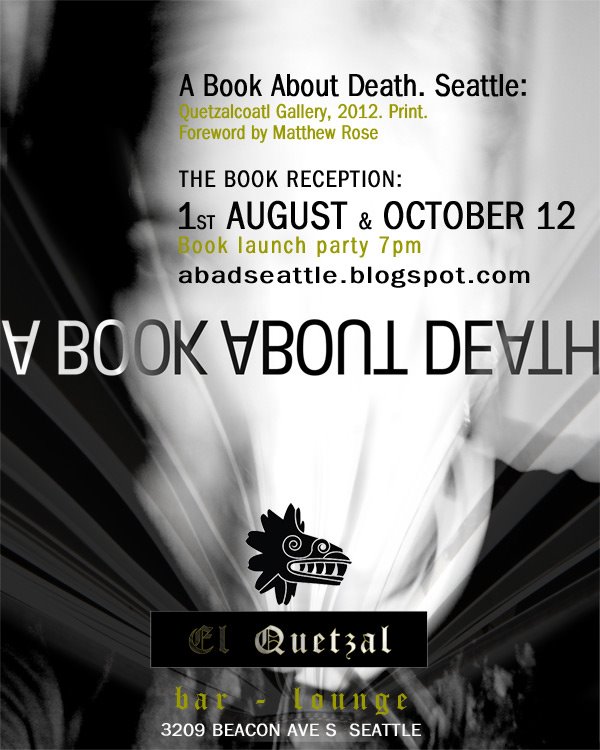
The Book: A Book About Death [206]

 
Conceived and produced by Almendra Sandoval and Kathleen McHugh from the exhibition A Book About Death Seattle at Quetzalcoatl gallery, the book is the first printed version if any of the more than 25 exhibitions in the ABAD project.  Foreword by Matthew Rose.  Opening launch party is on August 24, 2012 in Seattle.  Quetzalcoatl Gallery/El Quetzal Lounge 3209 Beacon Avenue South, Seattle.  

For more details please see: http://abadseattle.blogspot.fr/

Sunday, June 10, 2012

Brandstifter: Lost & Found in Mainz [205]

Brandstifter: Lost & Found 2012… Asphaltbibliotheque Mainz

June 06 - August 26, Main Station Square, 55116 Mainz

Brandstifter, the German conceptual artist who performed a cassette tape reading at the Emily Harvey Foundation Gallery opening of A Book About Death in 2009 has set up shop in Mainz, Germany.

The conceptual installation with lost & found sheets of paper from the streets of Mainz collected by Brandstifter are presented on the outside of an accessible wooden cube in front of main station for three months (through August)at the art in public space project by V.E.B. Freie Brandstiftung in cooperation with Kulturdezernat Landeshauptstadt Mainz.

Visitors or passerby can take part in the exhibition by submitting their found papers for the participative project in the mail box at the cube. The Asphalt Librarian will turn them into large Blow ups and integrate them into the constantly changing exhibition. Brandstifter developed his concept Asphaltbibliotheque for archiving found pieces of papers at Mainzer Galerie Walpodenstraße 21 in 1998.

Since then he collects and exhibits them worldwide for example 2009 as artist in residency at Flux Factory New York with grants by Schloss Balmoral, Stiftung Rheinland-Pfalz für Kultur. The three month exhibition will be guided by an opening reception on June 16, 6pm in the shape of an EXCHANGE BUREAU FOR LOST&FOUND SHEETS OF PAPER, a 24h performance with members of the performing arts ensemble “Raum (0)” on July 27, a FLUX exchange project arcross the river Rhine with Ben Patterson (A Penny for your thoughts) at the cube in Mainz and Brandstifter at Ben's Pavillion, Museum Wiesbaden as well as an art zine that displays the progress of the project and lost&found art that can be submitted by E-mail through brand@brand-stiftung.net

Monday, June 4, 2012

Joan Harrison: Sea & Sky [204]


The artist, curator and writer Joan Harrison opens June with art and literature.  Joan Harrison curated the Ray Johnson and ABAD exhibition at CW Post College on Long Island in 2011. 

Joan’s pastels of the sea and the sky will be on view at the Glen Cove Yacht Clulb starting Saturday June 9.  Her book, Locust Valley, will also be available for sale.  See Joan’s web site here: http://joanharrison.com/

Monday, May 28, 2012

Peter Schuyff: Second Chance (Uke) [203]

Peter Schuyff, artist living in Amsterdam, contributor to ABAD's show in NYC is also the guitar and uke playing, troubadour of The Woodwards. Here, he gives an impromptu ukelele rendition of (I think) Second Chance at his gallery in Amsterdam, Galerie Gabriel Rolt. You can also watch Peter's new music video, NOTHING, here: STOREFRONTWINDOWS.

Friday, May 25, 2012

Susan Shulman's Letter From Paris [202]


Above: Musée Maillol, Paris.  Read the post on Praeterita.

This is the second part of a dispatch from a visit to Europe by the three artists of the Seeking Kali Collective (Part 1 here). Artist Susan Shulman recounts what she saw in Paris -- including a visit to the apartment of the legendary Matthew Rose.  (Well, I don't know about legendary).  Anyway:  More here.


Friday, May 18, 2012

Bonnie Gloris: Renaissance, Rebirth, Revival [201]


ABAD artist Bonnie Gloris will exhibit her work in Renaissance, Rebirth, Revival a group exhibition with works that reflect a renewal of life, vigor, commerce, interest and hope.

Above: Mother/Mistress, 2010. Mixed media on paper, 20.5 x 16.25 inches

RSI: 1500 Irving Street, Rahway, NJ; May 20th – June 24th, 2012.

Opening Reception: Sunday, May 20, 11 a.m.-4:00 p.m.

More information, click: Bonnie Gloris.

Wednesday, May 16, 2012

ABAD SEATTLE: THE BOOK [200]


A Book About Death Seattle, curated by Kathleen McHugh and hosted by Almendra Sandoval will be a published book.  The 250-page book will be available by the end of July. The launch party is August 1.  For more information see: ABAD SEATTLE.

Sandoval, Almendra, ed. A Book About Death Seattle. Seattle: Quetzalcoatl, 2012. Print.
Foreword by Matthew Rose
— with Herb Sundvall, Almendra Sandoval and Matthew Rose at El Quetzal.

Sunday, May 6, 2012

Gloria Zein / London : I Can't Stop The Dancing Chicken [199]


Mural  and sculpture: Gloria Zein. Photograph stairwell: © Richard Bryant. Photograph sculpture: © Gloria Zein. 

Gloria Zein, an artist who helped launch the A Book About Death project in New York, opens her solo exhibition I can't stop the dancing chicken at the Goethe-Institut London on Sunday, 20 May 2012, noon to 8pm.

Goethe-Institut London 

I can’t stop the dancing chicken was commissioned specially for the 50th anniversary and reopening of the Goethe-Institut London.

It is a temporary installation in three parts consisting of individual works of sculpture, miniatures and a mural, which together form a complex, comprehensive spatial installation addressing the identity of the building and the structure of the Institut. It will be on show until April 2013.

There will also be a number of events:

1) Ten film screenings (22 May - 23 June) including short works by the artists Fiona Chambers, Marcus Coates and Anita Delaney and by director Helke Sander.

You can find the complete  program here:
http://www.goethe.de/ins/gb/lon/ver/en9182736v.htm

2) Artist Talk:  Gloria Zein in conversation with Stephanie Rosenthal, chief curator at the Hayward Gallery, on 3 July at the Goethe-Institut.

If you are in London, the artist will be in town on 20 - 22 May as well as 3 July, 2012.

Gloria Zein: I can't stop the dancing chicken
Goethe-Institut London  50 Princes Gate
Exhibition Road  London SW7 2PH

Please check the website for the new opening hours:
http://www.goethe.de/ins/gb/lon/knt/oef/enindex.htm
 

From the program: German artist Gloria Zein currently works between London, Berlin and Paris. In 2011 she was awarded the Cass Prize for Sculpture in London.

An interdisciplinary, dialogical approach is central to Zein’s practice; the disclosure of her artistic methods allows viewers to appreciate the processual nature of her projects and the conditions surrounding the creation of her sculptural pieces.

The works that have been developed in honour of the reopening and 50th anniversary of the Goethe-Institut London reflect the transdisciplinary nature of Gloria Zein’s art. Her commissioned pieces allude not only to the multifaceted role of the institute with its wide range of cultural and educational activities in London, Great Britain and North-West Europe, but also to the dedication and commitment of its staff, operating within a dynamic network of artistic and creative fields.

Following the extensive restoration of the premises and the redevelopment of the interior spaces, Gloria Zein has responded to the architecture of the building with references to its historical significance and to the cultural objectives of the Goethe-Institut London. The diversity and geographical structure of these are addressed in a complex artistic work. Sculptures and objects in a variety of materials have been installed both outside the building and in individual working areas, and Zein has also developed a striking and playful colour concept for the walls and ceilings of the main stairwell. Visitors experience this space as a walk-through installation that opens up fascinating and surprising new perspectives throughout the entire building.

This project is presented as part of the International Architecture and Design Showcase 2012; a global gathering of cultural projects investigating architecture and design from across the world.

– Claudia Amthor-Croft Head of Arts, Goethe-Institut London, spring 2012, Translated by Jacqueline Todd


Saturday, April 21, 2012

GRACE GRAUPE PILLARD's NEW YORK CITY BLUES [198]

Grace Graupe Pillard opens a show of New York works exploring the city, along with seveal other NY based artists.  NEW YORK CITY BLUES taps into the city as atmosphere, motif and symbol of the spirit of our time – and it opens in two art spaces in Denmark –  KUNSTPAKHUSET and Augustiana.  Along with Grace Graupe Pillard, Robin Tewes and the Danish artists Jonna Pedersen and Bjørn Eriksen visit the ins and outs of the city and its population thorugh photography, painting, video and other media.

Grace was one of the New York City artists who participated in the ABAD show at the Emily Harvey Foundation, and also made a film of her visit, visible on the main ABAD site, here.

New York City Blues 28. april – 28. maj 2012
KUNSTPAKHUSET
Lille Torv 5 7430 Ikast Tlf. 2311 1019 info@kunstpakhuset.dk www.kunstpakhuset.dk
 

24. juni – 19. august 2012
Augustiana – skulptur og kunstcenter  ved Galleri Nørballe
Palævej 12 6440 Augustenborg Tlf. 2220 2591 info@gallerinoerballe.dk www.augustiana.dk


Visit Grace Graupe Pillard's website here.

From the catalog:  GRACE GRAUPE PILLARD / The Spirit of our Time

In several of her works Grace Graupe Pillard addresses events of national and political character, which seem to have altered America’s awareness of its own role in the world, and its internal political conscious- ness, and has created a new ”spirit of our time.”


The terrorist bombing on September 11, 2001 of the spectacular Twin Towers - the World Trade Center skyscrapers in NYC, changed the USA and its perception of personal safety. The event changed the world so dramatically that there is now talk of a before and after 9/11.The monstrous event shattered the American self-image and revealed a vulnerability of unknown dimensions. It was literally the heart of the American system that was hit.


Grace Graupe Pillard visualizes the consequences of war and the equally powerful manipulation of the electorate through the “politics of fear”, which were created by politicians in the period after 9/11 and the ensuing war in Iraq. “Interventions - It Can’t Happen Here” attempts to make visually evident the ongoing tragic repercussions of war in ”far off places” transported to United States’ own backyard.
By use of computer and digital filters she creates an implanted imagery - sometimes verging on the abstract. Using bright colors and kaleidoscopic patterns, she depicts a recognizable everyday reality that is distur- bingly altered in character and mood. She makes a digital / photographic jolt of reality. As a viewer we ask ourselves: What is paranoia? What is reality?

Friday, April 13, 2012

Pre-Fluxus Time Travel Circus: LuAnn Palazzo [197]


ABAD artist and curator LuAnn Palazzo opens up an exhibition at The Second Avenue Firehouse Gallery in Bay Shore, New Yokr (on Long Island) that touches upon interspatiaion time travelling: Pre FLuxus Time Travel Circus.  The international mail system, the physical world and time are the subjects of this show that features selections from the high flying art world.

The exhibition opens on Sunday May 6, 2012, from 2 - 5 PM.  The exhibition fruns from May 6 through May 28.  Call: 631.669.3236.

For more information: http://www.secondavenuefirehouse.com/


Sunday, March 25, 2012

Willie Marlowe In Ireland : Neon Ribbon [196]


Willie Marlowe, a painter and original sponsor of the ABAD exhibition in New York will be showing new paintings and prints in Ireland at The Denis Collins Gallery's Art Upstairs, Wexford, Ireland.

Her works are luminous like the above piece, Neon Ribbon, a 26-inch square archival pigment ink print.   Willie will also show works at the Rosslare Gallery, Strand Road this spring.  To see more work, read about and contact the artist, connect here: Willie Marlowe.


Saturday, March 10, 2012

ONTOLOGICAL MUSEUM ABAD INSTALLATION [194]


Opening March 10, 2012, A Book About Death opens The Ontological Museum's big launch in Pagosa Springs, Colorado.

See more here: ONTOLOGICAL MUSEUM AT PAGOSA SPRINGS.

FRANS VAN LENT : AIRE [193]

Frans van Lent, one of the first artists to submit work to the ABAD show at the EHF invites the world to  an online preview of his new video-performance: Aire (2012).
Please follow this link: http://vimeo.com/fransvanlent/aire
Password: 2012aire

Wednesday, February 29, 2012

ABAD SAO PAULO: ANGELA FERRARA INTERVIEW [192]


Angela Ferrara interview about the ABAD Sao Paulo show...

Born in Sao Paulo, Angela Ferrara is painter, architect, designer and curator. Graduate in architecture and urban design in 2001 and postgraduate in Communication and Arts with emphasis in interior design in 2006 in Sao Paulo. In parallel to her work she’s also dedicated to visual poetry
and performance grounded in Fluxus philosophy.

Angela Ferrara is part of a generation of artists who seek to return to the conceptual aspect of 1960s, to search for new techniques in a extensive research of ornamental patterns. Her work makes references to Brazilian artists Aldemir Martins (1822-2006) and Burle Marx (1909-1994). The artist
participates in exhibitions and collections in United Estates, Europe, Brazil. Angela Ferrara works in a decorative patterning, influenced by the fauna and flora of Brazil, to create a work psychedelic and
geometric, but at the same time is organized and rhythmic.

website: http://angelaferrara.com

Friday, February 24, 2012

Assemblings At The Ontological Museum & ABAD [191]


Assemblings (Part One) – Inaugural Exhibition! From the Archives of the Eternal Network at the Ontological Museum (OM) in Pagosa Springs, Colorado, USA.

Opens: March 10, 2012 and runs through April 15, 2012
Location: 262 Pagosa Street, Pagosa Springs, Colorado 81147 – tel. 817-944-4000
Opening Reception: Saturday March 10, 2012 from 5:00pm – 7:00pm
Winter Hours: Tues through Saturday 2:00pm - 5:00pm

On view will be a selection of Assemblings including Franticham’s Assembling Boxes from Ireland; Art/Life Magazine, Tensetendoned - We Absorb assemblings; Fluxkits from Fluxpress Saint Louis, Bamboo Assemblings, KART magazine (an assembling publication from Australia); Fluxlist Fluxbox; Post cards from the assembling: A Book About Death; selections from the Fluxcase Micro Museum. Additional related works from the Permanent Collection will also be on view.

What are Assemblings?
Assemblings are collections or compilations of works of art, multiples, objects, writings, visual poetry and/or ephemera submitted by a network of participants to a single hub where a central editor collates one copy from each artists' edition of submitted materials into a number of portfolios. A common practice is for the editor to then send back one folio or assembling of works to each participating member. Assemblings might be in the form of a box of loose materials, a bound book or magazine format, etc. or even be a collection of sound works or short videos. On view for this exhibit are examples of assemblings in box form, magazine format, an unbound book and as collections of objects. In fact the museum itself is an assembling in its own right.

History of Assemblings
Assemblings - as shown in this exhibit - have been created since the early 1960’s as artists, writers, and small independent printers worked on developing alternative, underground distribution networks for their experimental art and literature. As the art and literary worlds came to be controlled by powerful and well established business interests that, in essence, were seen as cultural gate keepers, the creative community experimented with direct mailings and other self-initiated ways to reach out to their collaborators and extended audiences; what we would call today niche markets based primarily on networks of people with similar interests. This kind of experimentation led directly to the establishment of the international Mail Art community known as the Eternal Network which celebrates its 50 year anniversary this year as does Fluxus, an amorphous group of artists that has been highly influential in developing the Mail Art scene in the 60’s and 70’s and on through to the present.

About the OM
The Ontological Museum, established in 1994 as an experimental art museum, opens it’s new space in Pagosa Springs with this exhibition. The museum houses an internationally focused collection of art that numbers in the tens of thousands of items and growing through direct donations of works from artists. The museum collects inclusively within the parameters of its mission that includes several interrelated fields: collage, assemblage and constructive art in general as well as works from the contemporary Fluxus and Mail Art communities and the art groups: The International Post-Dogmatist Group, The Massurrealist Group, the International Society of Assemblage and Collage Artists and the Neoist Society. Also in the collection are snapshot photography, visual poetry, small press publications, artist books, and the plethora of documentation, correspondence art and ephemera related to these communities and groups.

The Ontological Museum - now open in Pagosa Springs, Colorado - has been a mobile museum keeping works in storage and using exhibition spaces in various locations including commercial art galleries, university galleries, contemporary art centers and museums around the country. The founding director, Cecil Touchon, has curated fifteen+ museum exhibitions and published more than twenty-five related books and catalogs since starting the exhibition program in 2007.
Visit online at http://ontologicalmuseum.org email: info@ontologicalmuseum.org

Sunday, February 19, 2012

TITO HONEGGER: MONTAGNEAU – GENEVA AND PARIS [190]


Tito Honegger opens a exhibition of new works at Galerie Michel Foex in Geneva, Switzerland on Wednesday February 29, 2012.

For information on Tito's work, see her web site: http://www.artsites.ch/titohonegger.html


In parallel to the exhibition in Geneva, Honegger will launch her collaboration with artist Jacques Jouet entitled "Un Enorme Exercice" – monotypes and texts in wire – along with a book entitled MONTAGNEAU, published by Art et Fiction.  The collaborative exhibition at the Parc culturel de Rentilly is near Paris, and runs from March 4 through May 4, 2012. For more information click here: Montagneu.

Galerie Michel Foex, 1 rue l’Evêché, 1204 Genève, Tél. : 41.022.311.2686

Saturday, February 4, 2012

PETER SCHUYFF: THE WOODWARDS LIVE IN BERLIN [189]

Artist Peter Schuyff, contributor to the NYC EHF ABAD show, is the genius behind the blues and country duo, The Woodwards.

The group will play Berlin on February 15 and 16 at Tausend and O.T. Projektraum. 

Schuyff's partner, the talented Stevie Guy will sing a couple of dozen original songs that pierce the heart and stir the brain.

For more info, tracks and a bit about the group see: The Woodwards


Thursday, January 19, 2012

RICK PROL LECTURE IN HUDSON VALLEY, NY [188]


Rick Prol, I Have This Cat, 1985; acrylic on canvas, wood and glass; 96 x 93 in. 

Rick Prol, a New York-based artist, and part of the ABAD exhibition in NYC in 2009 will lecture along with collector Ari Strauss during the exhibition Circa 1986, at the Hudson Valley Center for Contemporary Art in Peeksill, NY.  He will speak about his life in the New York art world.

When: Sunday, January 22, 2012, 4:00-5:00 pm 
Where: Hudson Valley Center for Contemporary Art, 1701 Main St, Peeksill, NY 10566.

Rick Prol, born and raised in NYC where he currently lives and works. He graduated from Cooper Union College in 1980 and began showing his work publicly in 1982 - during the then burgeoning East Village art scene. Prol was also studio assistant to painter Jean-Michel Basquiat.

"The East Village Art scene of the '80s thrived on the romance of slumming in an era of widespread economic prosperity. Rick Prol was one of the icons of that era, known for his cartoonish tableaux of mayhem, murder and suicide set in a rat-infested fantasy world somewhere East of First Avenue."
– July 1993, Art in America, Eleanor Heartney, via RickProl.com

Ari Straus was a young collector during the 1980s and the son of two collectors. Straus was excited by the cartoonish aesthetic employed by '80s artists. Even at a young age, he was an avid comic book reader, and Straus appreciated the bridge between "High" and "Low" art, which emerged during this period. Ari is currently CEO of Monticello Motor Club, a private race car establishment for automotive enthusiasts located 90 minutes north of NYC.

*Free with Museum Admission and for Members*

For more information contact:
JessicaDenaro@hvcca.org or call 914-788-0100

Tuesday, January 17, 2012

Graham McDougal at Cornell [187]


ABAD artist Graham McDougal opens an exhibition of his new work at the Milstein Gallery January 16th - February 11th and the Tjaden Gallery January 16th - 28th 2012.  The galleries are on the campus of Cornell University. 

Opening Reception, Thursday, January 26th, 2012. 5:00 - 7:00 pm, Milstein Gallery.

Graham McDougal's web site: http://www.madison-first.com/
More information: http://aap.cornell.edu

Tuesday, December 20, 2011

Fancy Fancy : Kim Jong-il [184]


Korean Central TV of the North, via Reuters
 
The body of Kim Jong-il lies at the Kumsusan Memorial Palace in Pyongyang in this image taken from video footage aired by Korean television on Tuesday, December 20, 2011.

Wednesday, December 7, 2011

Sin Fronteras at ABAD Seattle December 10, 2011 [183]


Abel Rocha and Patricia Mazuela from Sin Fronteras will bring music to ABAD SEATTLE at the c on December 10th. There is a suggested donation of $10 at the door. 

Sunday, November 20, 2011

Mitsu Sundvall : On Being Japanese In Post War America [182]

Mitsu Sundvall talks about her childhood as a young Japanese in the United States and the anti-Japanese sentiment through the prism of a best friend who saw through the then-prevalent prejudice rampant in post-War America.   She reads at A Book About Death Seattle on November 19, 2001.

Please blog or hit the FB or Twitter button to share this video and post. 

Friday, November 18, 2011

SEATTLE, ABAD & THE GRATEFUL DEAD [181]


The A Book About Death exhibition opened in Seattle on 11.11.11 to a big crowd and the iconic sounds of The Grateful Dead, thanks to both curator Kathleen McHugh and gallery owner Almendra Sandoval.

Jacques Migeon and his group The Tangletown String Band, played a full set of Grateful Dead music and folks came in and out looking at the work and enjoying this, the 25th exhibition of the project.

More than 110 works were received by the gallery and on Saturday November 19, 2011 (beginning at 5 PM local time), about a half dozen films and videos will be shown in the gallery along with a reading and literary event with Herb Sundvall

About the opening, Kathleen (pictured right, with Herb Sundvall and friend) writes: "On the night of the opening a group of people came in because they saw a flyer on a telephone pole. They were familiar with A Book About Death and had wanted it to come to Seattle. Many people in the crowd came down from Victoria, British Columbia thanks to Dame Mailarta and her friend "Snappy." They spent a couple of nights in Seattle and brought both friends and strangers they had met to the show. They are writing and talking about the show in Victoria now. It was a great suprise.  All in all a great evening."

You can see about 60 images from the show here: ABAD SEATTLE PHOTO ALBUM.

Friday, November 11, 2011

ABAD SEATTLE OPENS: SNEAK PEAK [180]


Hours before the opening of ABAD Seattle, curated by Kathleen McHugh, the walls are up and the show is readying to open its doors. 

Details:  Opening –  Friday, November 11, from 6 pm - 2 am at the Almendra Sandoval QUETZALCOATL GALLERY 3209 Beacon Ave S Seattle, Washington 98144.

The exhibition will close with a reception on December 10, from 6 pm -2 am.  For more information see the web site: http://abadseattle.blogspot.com/


Please retweet, blog and e mail this post to all interested parties.  Thank you.

Friday, November 4, 2011

TANGLETOWN STRING BAND : OPENING ABAD SEATTLE WITH GRATEFUL DEAD SET 11.11.11 [179]


Jacques Migeon and his Tangletown String Band will open the ABAD Seattle exhibition with a full set of music from The Grateful Dead.  The Tangletown String Band is a Seattle musical staple.  "We are extremely pleased to be part of this worldwide exhibition and contribute a musical component to this current chapter of the show," says Migeon, a Seattle local.

The Tangletown String Band is a collection of passionate musicians with good day jobs which they have no intention of abandoning. "We emerged from the basement practice room a couple of years ago and now have a couple of sets of tunes drawing equally from "Old Time" Music, Bluegrass, Alternative Country, and a handful of originals that could easily fall in the aforementioned genres.," says Migeon.

Tangletown has been seen playing at variety of Americana music events around Seattle for years.  "We have been heard to say, with pride, 'I’m with the band' or 'I have rehearsal tonight,'" says Jacques.  "Mostly however, we just love to make music with our friends and share that with whomever we can.  At full strength, the band has seven members with Jacques and George on guitar, Karen on fiddle, Peter on Mandolin, David on Bass, John on Banjo, and Mary on vocals and back-up bass.  A veritable forest of microphones can be found on stage as all of us like to sing creating very rich harmonies."

See videos, listen to their music on their website: Tangletown String Band

The Tangletown String Band on FaceBook.  Give them a LIKE.

Ira Schneider's 11.11.11. [178]

ABAD artist Ira Schneider opens his 11.11.11 on 11.11.11. 

Ira Schneider is an American artist living and working in Berlin.  He has a long history with the Emily Harvey Foundation.

WHEN: Opening / Vernissage 11.11.2011, 8pm/20h –  Exhibition/Ausstellung 11.11. bis 23.11.2011

WHERE: Prima Center Biesentalerstr. 24 13359 Berlin, Germany.

Ira Schneider:  http://www.ira-schneider.com

Tuesday, October 25, 2011

ABAD History To Date [176]

2011  Quetzalcoatl Gallery, Seattle, WA / November 10 – December 10
Second Avenue Firehouse Gallery, Bay Shore, NY / ABAD: The Ties That Bind / July 31 – September 2
Willo North Gallery, Phoenix, AZ / ABAD: Memento / May 3 – 28
Chiesa S. Antonio Piazza La Rotonda Badoere di Morgano, Treviso, Italy / Un libro sulla Morte omaggio a Ray Johnson / April 9 – 17
Elizabeth Stone Harper Gallery, Presbyterian College, SC / ABAD Life / January 20 – February 25

2010 SAL Gallery, CW Post Campus-LIU, Brookville, NY / Ray Johnson & A Book About Death / November 1 – 6
Belknap Mill Gallery, Laconia, NH / October 29–November 1
The Fluxmuseum, Fort Worth, TX / October 8 – 30
Jaffe Center for Book Arts, Florida Atlantic University, FL / July 15 – October 18
The RNG Gallery, Omaha, NE / Till Death Due Us Part / July 31 – August 28

Villa Torri & Biblioteca Comunale, Vimodrone, Italy / May 8-19
Museum of Modern Art, Wales, UK / April 27 – May 8
Exit 11 Contemporary Art, Grand-Leez, Belgium / April 11 – June 27
ASA Art Gallery, Sarajevo, Bosnia and Herzegovina / April 1 – 15
Prostor, Zagreb, Croatia / March 22–30
Steppling Art Gallery, San Diego State U, CA / ABAD Mexicali / March 10 – April 9
Vladimir Nazor Library, Zagreb, Croatia / February 26 – March 21
Museu Brasileiro da Escultura, Brazil / Um Livro Sobre A Morte / February 6 – 28

2009 La Sexta Literary Arts Festival, Tijuana, Mexico / November 21
Queens Museum of Art, NY / November 1 –15
River Mill Art Gallery, Westfield, NJ / October 17–31
Ripe Art Gallery, Greenlawn, NY / October 11–18
Otis College of Art and Design, Los Angeles,CA / October 11–31
Mobius, Boston, MA / September 19 – 20
Emily Harvey Foundation Gallery, Soho, NY / September 10 – 20


IMAGE TOP: EHF DIRECTOR, CHRISTIAN XATREC, INSTALLING WORKS AT THE EHF, NYC, 2009.  IMAGE MIDDLE: INSTALLATION AT THE OTIS COLLEGE OF ART AND DESIGN, LA, CA, 2009.  IMAGE BOTTOM LEFT: INSTALLATION ABAD AT THE QUEENS MUSEUM, 2009.

Saturday, October 8, 2011

HEATHER MATTHEW: Collaborative Arts Practice [172]


Contemporary Debates in Visual Culture
Contemporary Collaborative Arts Practices


presentation by
Alix Brodeur
Christine Huntsman
Heather Matthew
Rebecca Moon
Miriam Salomon
Kaye Wearne


Collaborative Arts Practice
Since the 1990’s there has been resurgent interest and participation in collaborative art practice as it became incorporated into the mainstream. There is, however, a long and complex history of collaboration ranging from the hierarchical large scale studios of the Renaissance, through Surrealist Group experiments, Fluxus games and Andy Warhols pseudo industrial factory.
Groups may be fixed and formal, or they may be loose informal networks of friends living and working side by side. Motivation varies from the ability to share tasks according to skills, promotional and economic benefits, to the fun and joy derived from working with others. 

But visual artists have also laboured under the idea of the artist as an heroic solitary figure whose ‘voice’ or personality is expressed through their art to give it authenticity. This authenticity ties in with the issue of authority or “authorship” which has remained central to the debate about art as a saleable commodity. These notions of the individual, academic or gallery based artist were challenged during the 1960s by collectivist, anti-establishment, collaborative arts movements such as Fluxus.
Fluxus had its roots in Dadaism but grew out of the musical performances of composer John Cage during the 1950s and moved into the visual arts during the 1960s with artists such as George Maciunas, (text and ‘boxed’ art), Allan Kaprow (Happenings) and Joseph Beuys (sculpture). Perhaps its most famously linked artist is Yoko Ono who collaborated with John Lennon in 1969 staged the famous “Bed In’.
This was a time of massive social and cultural upheaval when the very ideology of class, race, gender, and authority were being challenged and disseminated through the mass media and counter culture movement. From the Paris riots of 1968 through to the antiwar demonstrations in America and Europe of the 1970s, art became bound with politics, art was seen as an instrument for social change, art embraced the Marxist idea of the collective.
This idea of non-individual ‘collectivity’, through collaborating arts practice instead of saleable individual art in a gallery undermined the whole market value approach to art. A new ideology was beginning to take shape and be espoused by thinkers of the time. 

Art was now becoming embedded in ‘context’ and ‘culture’, the artist inheriting a foundation and history, creating a “ language of decipherable metaphors whose purpose is to explore aspects of contemporary society’. With such ideology in place collaboration could be recognised as a legitimate arts process or arts practise, creating ‘art’ in isolation no longer applied.
Collaboration duos like Gilbert and George who challenged notions of art in the 1960s with their “Singing Sculpture”, went on to become ‘mainstream’ artists in the 1980s when they won the UK Turner Prize. The whole notion of authorship was explored by collaborative duos like Christo and Jeanne Claude who after thirty years of working together as Christo then decided to use both their first names as a form of ‘authorship’.  Other collaborations like the 1980s group Guerilla Girls formed teams whose members remained anonymous.
The problems around authorship became particularly important in art schools where allocating marks was dependent upon individual students’ work. Collaboration as a serious arts practice was therefore not actively encouraged by art schools. A famous example of this was UK artists Jane and Louise Wilson, identical twins born in 1967, who attended art college at separate locations, one in Newcastle the other in Dundee. They produced a collaborative artwork for their final degree show and submitted the same work to their respective art colleges. 
Their relationship as twins is not played out as their collaborative practice, although reviewers have noted each will refer to “my work” or express what “I hope to achieve with the work”, whilst in the presence of the other sister.  So they work as a seamless duo without apparent delineation of separate roles, therefore blurring the notion of the single identifiable author.
Jane and Louise Wilson’s work takes the form of multi media video installations filmed on location and frequently at sites associated with oppressive institutional power. Many of the sites are examples of modernist architecture and utopian design, or sites associated with cold war politics. They are filmed in their now desolate and ruined state, devoid of those invested with the power to instill fear, yet the installations are still capable of provoking collective anxiety. Here the work of Michel Foucault on notions of power and hierarchy and how this affects behaviour when in particular spaces is particularly influential. They are about making the familiar unfamiliar by evoking a sense of the uncanny. 
This sensibility leads the audience to question modernity’s ideology of progress, and optimism for a better future through scientific and industrial development. Stasi City and Gamma (1999) are a paired installation, with Stasi City filmed at the now abandoned Stasi headquarters in the former East Germany and Gamma at abandoned nuclear missile silos at Greenham Common near London. In both, the camera shows quiet empty rooms and spaces that were once sites of fear and interrogation, now conveying a sense of human folly. The sisters appear ghostlike and dressed in uniform, gliding through the space silently. It is not without humour, as one of the sisters is seen passing over the space in a flying harness.


This interest in architectural spaces extends from the film content into the design of the multi screen installation. Through the kinetic placement of screens the viewer moves through and activates the installation space. The casting of their shadow onto the screens enhances the sense of being actively involved in interpretation and the process of making meaning. This is evident in the work “A free and anonymous monument” (2004) filmed on location around Newcastle-upon-Tyne in the U.K. The work is based on a now derilect public monument (The Apollo Pavilion) designed by the artist Victor Pasmore as a sculptural centerpiece for a utopian style housing development on the edge of the city. The images also include sites of industrial ruination in the area and contrasts these with recent laboratories associated with the digital age.  Fragmentation occurs as images move from sites of industrial demise to the quiet and seeming invisibility of our digital age. There are 13 screens installed to mirror the design of the original Apollo Pavilion, giving the viewer a sense of being immersed in the location, surrounded by memory and association.
Occupying public space physically and in large numbers as a collaborative arts practice is another alternative to gallery based art exposure.
When discussing contemprary collaborative art, it is important to recognize flash mobbing and culture jamming as two, if not obvious, legitimate practices. 

Culture jamming could be defined as a disruption of our society’s norms and cultural standards as a way of gaining perspective as to why we “do what we do”. This is a common practice in social movements currently, usually directing attention and questioning towards consumerism and politics. One example is Critical Mass, an event held typically on the last Friday of every month in over 300 cities globally, where citizens (usually hundreds) cycle the streets. Some say this leaderless event is to draw attention to global warming, some say it is a way of cyclists reclaiming the streets.
Flash mobbing on the other hand, has become popular as a large group of people who assemble in a public area, usually perform some sort of action, then leave suddenly. In London, in 2006, the “silent disco” was staged where at a set time in the Underground, everyone with portable music devices began dancing. Similiarly, in the New York subway, “No Pants Day” has become an annual event where, everyone participating, just as it sounds, rides the train in jackets and scarves, but no pants. Worldwide Pillow Fight Days are also gaining popularity.
These sorts of events are worthy of recognition when discussing collaborative art. They are usually ambiguous in nature without leaders or formal organization. Some might say they have no “point” which is exactly their “point”. They challenge the archetypal roles of artist and audience, by using the participants as the artists themselves.
 New media and advanced communication is now integral to collaborative arts practices and the internet has enabled groups of artists to collaborate on projects all around the world. Some international collaborative art projects operate as a mixture of unselected mail art works which are then collected and combined under the ‘facilitating authorship’ of a single artist.
An example of this collaborative project was the postcard art Book About Death which originated as an internet call out open to anyone who submitted a postcard on the theme of death to Paris based artist Matthew Rose. Each participant was required to send 500 copies of their postcard to be included in an exhibition at the Emily Harvey Gallery in New York. The idea was that the 500 artists who responded to the call provided their work for free to contribute to an unbound’ Book about Death .
Visitors to the exhibition were then encouraged to collect one of each of the postcards to create their own unbound book about death, resulting in huge crowds at the opening night. Some artists who collected the entire range of postcards then exhibited the exhibition in other galleries in New York and further exhibitions have taken place in Brazil, Wales, Belgium, Croatia and Sarajevo with a proposal to exhibit in China under consideration.

 As organiser Matthew Rose says:
What is compelling for me is that artists have taken on this project as a mission of their own and given it in each turn in their own country a beautiful and personal shape.  (1a)
In some ways this collaborative arts project referenced the ‘out of gallery’ ethos of the original Fluxus movement, Emily Harvey herself was a supporter of Fluxus in the 1960s.
The concept that collaborative art could operate as a force for social change and allow marginalised voices to be heard outside of the traditional gallery selection processes and restraints is one which is seriously pursued by other collaborative arts groups.
One such group is Los Carpinteros , a Cuban art collective formed in 1991, based in La Habana and working and showing internationally. Initially a trio of classmates from the Instituto Superior de Arte (ISA) formed by Alexandre Arrechea (b.1970), Marco Antonio Castillo Valdés, (b.1971) and Dagoberto Rodríguez Sanchez (b.1969) it became a duo since Arrechea’s 2004 departure. Their work is part of the permanent collections of the Los Angeles County Museum of Art, The Museum of Modern Art, New York, the Guggenheim Museum, New York, and the Museo Nacional Centro de Arte Reina Sofía, Madrid amongst others.
Their name, which means Carpenters, pays homage to and deliberately inserts them into to the tradition of guilds of artisans, and tobacco and sugar cane workers while referring to their decision to renounce the bourgeois notion of individual authorship. It was also a way to protect themselves from unwanted attention from the authorities at a time when mass migration of artists had made the remaining ones highly vulnerable.
      
     ‘We did not want our work censored. So we disguised it. We cloaked it in a mantle of manuality and manufacture’1
They are, in fact highly accomplished woodworkers who make sculpture and installations in a variety of media often related to architecture and furniture but also cloth, as in their tent city and rubber on their serial sculpture of rubber sandals. Their work humorously explores the relation between architecture and design and between art and craft. Their drawings are often a point of departure for works in other media and act as mock architectural drafts that are later mirrored in their three dimensional work. Charles Merewether points out that this process of ‘going back to the drawing board’ and planning every detail in advance is one that has long been embraced by socialist thinkers. 2 They have referred to their drawings as ‘messages we send to each other’.

Los Carpinteros have chosen -and often talked about- a form of subtle protest and socio political commentary. Their man size wooden grenade, ironically titled ‘Jewelery Box’ and their ‘Bread Box’ shaped like a missile could be read as pacifist monuments while playing with the postmodern question of relationship between object and text. Their installation called library 1, 2 and 3 is a series of wall mounted measuring tapes containing sections of banned books, an obvious comment on censorship and possibly a dangerous one for Cuban artists to make. Their position is unusual, as Jorge Reynoso Polenz has pointed out 3, in that there is a clear interest by Cuba in promoting Los Carpinteros -a highly successful exportable product- which gives them a certain margin to express themselves freely and importantly, the freedom to travel.
They are currently working on their first long term US public commission, a large-scale site-specific interactive installation titled Free Basket for 100 Acres for the Virginia B. Fairbanks Art and Nature Park opening in June as part of the Indianapolis Museum of Art. The drawings for this work -which draws on the form of a basketball court- are computer generated and look very different from earlier ones, which used the palette of antique frescos. Conceptually however this new work continues to explore their long held interest in juxtaposing the practical and the imaginary.
Another major benefit of working collaboratively is the opportunity to pool resources as well as skills and ideas. Economic considerations can be a major hurdle for individual artists and working collaboratively often gives artists the opportunity to create large scale works.

This is particularly evident in the work of contemporary Healy and Cordeiro who bring a range of individual skills and sensibilities to create major installations which focus on contemporary issues like consumer consumption and its associated problems.
Claire Healy and Sean Cordeiro are two Australian born artists who began collaborating on works in 2002 during the final years of studying their masters in fine arts at the university of NSW. 
 They work with ideas of home, permanency and collection, and develop sculptural works in a variety of media.  Through their works they raise socio-political issues such as capitalism, globalization and consumption.
Their installations contain the everyday consumables and debris of modern life.  Healy and Cordiero explore creation and consumption, questioning the layers that disguise the simple economics that underscore our increasingly complex lives. An example of this found in their huge garbage ball, the garbage coming from an abandoned studio, they were to use. This illustrates the contradiction between material affluence and the uncertain income of artists in western society.
These two artists look closely at using resource sustainability, acquiring as little as possible and use material found on site without adding more objects to the mass of stuff.  They also up-cycle garbage to art forms and in so doing make the material and immaterial value of the raw material visible.  


In their “The Cordial Home Project” exhibition, they were looking at the average suburban home and the emotional and monetary values we put on them. They took apart a house, with the help of a team of 40 people, and stacked all the material into the exhibition room.  This house was the only house that the artists could afford and the artists were looking at the fact that they represent a generation of Australian citizens who will no longer be able to own their own home. They are also looking at the amount of rubbish that is left behind when a person moves house.
 Their site specific investigations of certain places are also investigations into the perception of the way things shift.   Healy and Cordeiro’s  “Flat Pack” installation in the  “There is a Life After the Trailer Park” exhibition in Berlin showed 4 meticulous stacks, all being exactly the same dimensions.  The fragments for these stacks had come from an abandoned trailer that a woman had lived in for 40 years.  The trailer had never been moved in this time.  There is a marked difference to Healy and Cordeiro’s lifestyle, constantly on the move, flying from country.  In this exhibition they are investigating an outmoded form of mobility, represented by the trailer, and adjusting it to current forms of travel.  Instead of the trailer being towed by a vehicle it has been taken apart, packed up, and flown to a different site.
At the Contemporary Art Biennale, (Lyon, France), Healy and Cordeiro used a Lego block model of a certain region in China, known as China’s “area 51”.  This region was discovered by Google Earth in 2006 and appears to be an exact replica of the 157,500 km sq of the Chinese province Aksai Chin. It borders in India and Pakistan and connects Tibet with a road that the Chinese built in 1962. The artists are just considering this little mystery and by making a portable replica of the existing model they are bringing it to the attention of the world.

 Healy and Cordeiro’s exhibition showing a bizarre block of 105,774 VHS video cassettes arranged inside a church, mulls over the human condition of the meaning of life and death.  The combined running time of the cassettes is enough to record the lifetime of the average person, being 66.1 years. “Life Span” is the physical representation of what may flash before ones eyes in the moments before death. The installation takes over the small church and substitutes film for religious doctrine as a vehicle for finding tranquillity and spiritual fulfilment.  The stack of outdated media becomes a metaphor for society’s manufactured packaging of experience and emotion and for the ultimate transience of life. Claire Healy has acknowledged that to send garbage half way round the world for exhibition is ecological nonsense, but concludes that it is what the art world demands. –
And what the world demands also is to participate in the experience of art, whether that be going to blockbuster art exhibitions or being part of the flash mobbing phenomena, the mail art phenomena, or just teaming up with friends to create art outside of gallery spaces.
That artists who collaborate with each other for shared inspiration, economy and the fun of working together on a shared vision now exhibit in major art biennales is a testament to how well they work together and how art as a collaborative process is very much in demand.

NOTES
a Matthew Rose A Book About Death: The Project Rolls On - Some News
April 8, 2010    http://www.facebook.com/groups
 1- Dagoberto Rodriguez in an interview with Rosa Lowinger The Object as Protagonist, published in Sculpture Magazine, Dec. 1999
 2- Merewether, Charles. Los Carpinteros in Vitamin D: New Perspectives in Drawing London, UK: Phaidon Press Limited, 2005
3- Reynoso Pohlenz, Jorge. Los Carpinteros: Utopian model makers published in Afterall, Issue 9 Spring/Summer 2004